Élasmobranches (requins et raies) (sharks and rays) >
Rhinopristiformes (Shovelnose rays) >
Rhinidae (Wedgefishes)
Etymology: Rhynchobatus: Greek, rhingchos = snout + Greek, batis, -idos = a sting ray (Raja sp.) (Ref. 45335); springeri: Named for Stewart "Stew" Springer.
Eponymy: Stewart ‘Stew’ Springer (1906–1991) was a field naturalist who dropped out of Butler College (1929) but was awarded a baccalaureate by George Washington University (1964), by which time he was world-renowned as an expert on both the taxonomy and [...] (Ref. 128868), visit book page.
More on authors: Compagno & Last.
Environnement : milieu / zone climatique / profondeur / gamme de distribution
Écologie
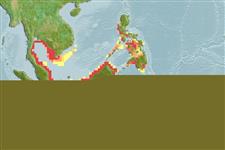
marin; saumâtre pelagic-neritic; profondeur 16 - 37 m (Ref. 84284). Tropical; 20°N - 10°S, 95°E - 128°E (Ref. 114953)
Indo-Malay: from Java (Indonesia) to Thailand, including Borneo, Singapore and the Philippines.
Taille / Poids / Âge
Maturité: Lm ? range ? - 125 cm
Max length : 215 cm TL mâle / non sexé; (Ref. 84284); 213.0 cm TL (female)
Description synthétique
Clés d'identification | Morphologie | Morphométrie
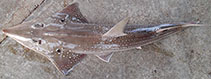
This moderate-sized species is distinguished by the following set of characters: snout broadly wedge-shaped; preoral snout 16-22% of total length; eye small, length 3.1-4.0 in preorbital snout; interorbital space 2.2-2.7 in preorbital snout; mouth hardly bowed, with strong indentation on upper jaw near symphysis and strong protuberance on lower jaw; tooth rows in upper jaw about 52 (holotype); dorsal snout no spines; dorsal tip of snout with no rostral spines or spines; supraorbital spines small but well differentiated, extending from preorbit to end of spiracle; spines of mid-dorsal row relatively well developed; two obvious rows of small scapular spines on each side; origin of first dorsal fin over origin of pelvic fin bases; predorsal space 42-48% of total length; colour pale greyish green above with 3-4 rows of large, white spots extending along the tail; black pectoral marking distinct, usually closely surrounded with 4 white spots (occasionally 3); anterior pectoral disc with narrow whitish margin; orbital membrane with a pair of dark, widely spaced, recurved lines; interorbital space with no alternating light and dark markings; propterygial radials 1-8 + 20-23, mesopterygial radials 4-6, neopterygial radials 4-7, metapterygial radials 23-29, total radials 57-68 (inc. free radials); vertebrae with 12-14 synarcual centra, 18-28 monospondylous precaudal centra, 78-88 precaudal free centra, 33-40 diplospondylous caudal (free) centra, 113-126 total free centra, 127-139 total centra (including synarcual centra) (Ref. 84284).
Body shape (shape guide): elongated.
Apparently confined mainly to brackish coastal and estuarine habitats in shallow water (Ref. 84284). Diet unknown, but presumably similar to other wedgefishes. Males mature at around
115 cm TL (Ref. 114953), two male paratypes from Sarawak (Malaysia) (IPPS 2009–338, adult male 112.6 cm TL) and Thailand (CAS-GVF 2361 unreg) were fully mature at 113 and 125 cm TL respectively, suggesting that this species is a moderate-sized wedgefish rather than a large species (Ref. 84284).
Cycle de vie et comportement reproducteur
Maturité | Reproduction | Frai | Œufs | Fécondité | Larves
Compagno, L.J.V. and P.R. Last, 2010. A new species of wedgefish, Rhynchobatus springeri (Rhynchobatoidei, Rhynchobatidae), from the Western Pacific. 77-88 pp. In Last, P.R., White, W.T. & Pogonoski, J.J. (eds.): Descriptions of new sharks and rays from Borneo. CSIRO Marine and Atmospheric Research Paper no. 32. (Ref. 84284)
Statut dans la liste rouge de l'IUCN (Ref. 130435: Version 2025-2 (Global))
Menace pour l'homme
Harmless
Utilisations par l'homme
Outils
Articles particuliers
Télécharger en XML
Sources Internet
Estimations basées sur des modèles
Température préférée (Réf.
123201): 28 - 29.1, mean 28.7 °C (based on 160 cells).
Indice de diversité phylogénétique (Réf.
82804): PD
50 = 0.5024 [Uniqueness, from 0.5 = low to 2.0 = high].
Bayesian length-weight: a=0.00372 (0.00166 - 0.00830), b=3.11 (2.91 - 3.31), in cm total length, based on LWR estimates for this (Sub)family-body shape (Ref.
93245).
Niveau trophique (Réf.
69278): 3.6 ±0.6 se; based on size and trophs of closest relatives
Vulnérabilité de la pêche (Ref.
59153): Very high vulnerability (90 of 100).
🛈