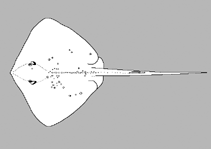
वर्गीकरण / नाम
आम नाम | उपशब्द | Catalog of Fishes(वर्ग, प्रजाति) | ITIS | CoL | WoRMS | Cloffa
इलाज़मौबरांकी (शारक और रेज़) (sharks and rays) >
Myliobatiformes (Stingrays) >
Dasyatidae (Stingrays) > Hypolophinae
Etymology: Pastinachus: Latin, pastinaca = a sting ray (Ref. 45335); gracilicaudus: Name from Latin 'gracilis' meaning slender, thin and 'cauda' for tail, appendage; referring to the slender appearance of the tail and narrow ventral cutaneous fold, as compared to other members of the genus Pastinachus.
More on authors: Last & Manjaji-Matsumoto.
पर्यावरण: पर्यावरण / जलवायु क्षेत्र / गहराई सीमा / वितरण सीमा
पारिस्थितिकी
समुद्री बेनथोपिलाजिक; गहराई सीमा ? - 60 m (Ref. 90102). Tropical
Western Pacific: This species is reasonably common but patchily distributed in both Malaysian and Indonesian Borneo, including Sabah, Sarawak, and western and northeastern Kalimantan. Possibly more widespread in the Indo-Malay Archipelago, east to at least the Wallace Line and the the identity of a specimen collected off Beruwala (Sri Lanka) needs confirmation.
आकार / वज़न / आयु
परिपक्व अवधि: Lm ? range ? - ? cm
Max length : 74.7 cm WD पुल्लिंग / अलिंग; (Ref. 84288); 83.0 cm WD (female)
संक्षिप्त वर्णन
पहचान कुंजी | आकृति विज्ञान | मौरफोमैटरिक्स
This medium-sized species (attaining about 75 cm DW) is distinguished by the following set of characters: snout rounded, not produced, angle more than 115°, apex largely naked and lacking enlarged denticles; disc length 83-89% DW; head length 38-41% DW; preoral length 15-17% DW; distance between nostrils 7-8% DW; distance between first gill slits 18-20% DW; tail compressed above mid-base of ventral cutaneous fold, its width 0.5-0.8 times its height; ventral fold low and slender, length 0.7-1.0 times DW, 17-22 times its depth below its mid-base, depth 2.0-3.6 times tail height at its mid-base; distance from anterior cloaca to sting 0.8-1 in precloacal length; two large, midscapular pearl thorns, usually preceded by a smaller irregular thorn; 120-122 pectoral-fin radials; monospondylous vertebral centra (exc. synarcual) 37-40 (Ref. 84288).
Body shape (shape guide): other.
The depth occupied by this species is unknown as most material were collected in fish markets, but probably mainly coastal. A 69.5 cm DW adult male weighed ca 12 kg. Size at birth apparently variable; 83.0 cm DW female delivered a full term embryo with small umbilical scar; however, other retained specimens, 26.1 cm DW still had a substantial yolk sac, while in another 19.3 cm DW specimen the umbilical scar was barely visible. All these young specimens have large mid-scapular tubercles and well-developed denticles over most of the dorsal disc; a small embryo with yolk sac (16.5 cm DW) had prominent mid-scapular tubercles, but other denticles are just starting to form on the disc (Ref. 84288).
जीवन चक्र और संभोग व्यवहार
परिपक्व अवधि | पुनरुत्पत्ति | मछलीऔ का अंडे देना | अंडे | उपजाऊपन | लार्वा
Last, P.R. and B.M. Manjaji-Matsumoto, 2010. Description of a new stingray, Pastinachus gracilicaudus sp. nov. (Elasmobranchii: Myliobatiformes), based on material from the Indo-Malay Archipelago. pp. 115-128. In Last, P.R., White, W.T. & Pogonoski, J.J. (eds.): Descriptions of new sharks and rays from Borneo. CSIRO Marine and Atmospheric Research Paper no. 32. (Ref. 84288)
आईयूसीएन रेड लिस्ट स्थिति (Ref. 130435: Version 2025-2 (Global))
मनुष्यों के लिए ख़तरा
Harmless
मानव उपयोग
साधन
विशेष रिपोर्ट
XML डाउनलोड करें
इंटरनेट स्रोत
मॉडल पर आधारित अनुमान
जातिवृति विविधता सूचकांक (संदर्भ
82804): PD
50 = 0.5312 [Uniqueness, from 0.5 = low to 2.0 = high].
Bayesian length-weight: a=0.01000 (0.00244 - 0.04107), b=3.04 (2.81 - 3.27), in cm total length, based on all LWR estimates for this body shape (Ref.
93245).
ट्रॉफिक स्तर (संदर्भ
69278): 3.7 ±0.6 se; based on size and trophs of closest relatives
मछली पकड़ने की भेद्यता (Ref.
59153): Very high vulnerability (90 of 100).
🛈