Classificazione / Nomi
Nomi Comuni | Sinonimi | Catalog of Fishes(Genere, Specie) | ITIS | CoL | WoRMS | Cloffa
>
Perciformes/Zoarcoidei (Eelpouts and pricklebacks) >
Zoarcidae (Eelpouts) > Lycodinae
Etymology: Ophthalmolycus: Greek, ophthalmos = eye + Greek, lykos = wolf (Ref. 45335); eastmani: Named for Dr Joseph T. Eastman, in honour of his contributions to knowledge of Antarctic fish.
Eponymy: Dr Joseph Thornton Eastman (d: 1944) is Professor Emeritus of Anatomy, Ohio University. [...] (Ref. 128868), visit book page.
Ambiente: milieu / zona climatica / distribuzione batimetrica / gamma di distribuzione
Ecologia
marino demersale; distribuzione batimetrica ? - 1837 m (Ref. 84360). Polar; 68°S - 69°S, 86°W - 87°W
Southern Ocean: Bellingshausen Sea.
Dimensione / Peso / Età
Maturità: Lm ? range ? - ? cm
Max length : 36.9 cm SL maschio/sesso non determinato; (Ref. 84360); 35.5 cm SL (female)
Breve descrizione
Chiavi di identificazione | Morfologia | Morfometria
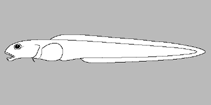
Vertebre: 117 - 118. Ophthalmolycus eastmani can be distinguished from its congeners by the following combination of characters: two posterior nasal pores; epidermal prickles on lips and snout; gill slit extending ventrally to the lower margin of the pectoral fin base; vertebrae asymmetrical 26 − 27 + 91 − 92 = 117 − 118; dorsal fin rays 111–113; dorsal fin origin associated with vertebra 6, with no free pterygiophores; pectoral fin rays 17–18; two postorbital pores; lateral line with ventral and mediolateral branches; scales extending anteriorly to just anterior to the anal fin origin; six branchiostegal rays; oral valve nearly reaching the anterior edge of vomer; palatine teeth in two rows anteriorly; 3–5 pseudobranch filaments; two well developed pyloric caeca; pelvic fin and vomerine teeth present (Ref. 84360).
Body shape (shape guide): eel-like; Cross section: circular.
Ciclo vitale e comportamento di accoppiamento
Maturità | Riproduzione | Deposizione | Uova | Fecondità | Larve
Matallanas, J., 2011. Description of two new species of Ophthalmolycus (Teleostei: Zoarcidae) from the Southern Ocean and key to species of the genus. Journal of the Marine Biological Association of the United Kingdom. (Ref. 84360)
Stato della Lista Rossa IUCN (Ref. 130435: Version 2025-2 (Global))
Minaccia per l'uomo
Harmless
Usi umani
Strumenti
Rapporti speciali
Scarica XML
Fonti Internet
Stime basate su modelli
Indice di diversità filogenetica (Fonte Biblio.
82804): PD
50 = 0.5010 [Uniqueness, from 0.5 = low to 2.0 = high].
Bayesian length-weight: a=0.00120 (0.00057 - 0.00253), b=3.10 (2.91 - 3.29), in cm total length, based on LWR estimates for this (Sub)family-body shape (Ref.
93245).
Livello trofico (Fonte Biblio.
69278): 3.5 ±0.4 se; based on size and trophs of closest relatives
Resilienza (Fonte Biblio.
120179): Molto basso, tempo minimo di raddoppiamento della popolazione più di 14 anni (Preliminary K or Fecundity.).
Vulnerabilità della pesca (Ref.
59153): Moderate vulnerability (35 of 100).
🛈