klasifikasi / Nama
Nama-nama umum | Sinonim (persamaan) | Catalog of Fishes(Marga, Jenis) | ITIS | CoL | WoRMS | Cloffa
>
Beloniformes (Needle fishes) >
Adrianichthyidae (Ricefishes) > Oryziinae
Etymology: Oryzias: Greek, oryza = rice; because of the habitat used by this fish (Ref. 45335); songkhramensis: Named for the Songkhram River basin region of Thailand.
Lingkungan: lingkungan / zona iklim / kisaran kedalaman / jangkauan distribusi
Ekologi
; air tawar pelagis, permukaan. Tropical
Asia: Songkhram and Mekong River basins, Northeastern Thailand
Ukuran / Berat / umur
Kematangan: Lm ? range ? - ? cm
Max length : 1.9 cm SL jantan/; (Ref. 84389)
deskripsi pendek
Kunci identifiaksi (pengenalan) | Morfologi | Morfometrik
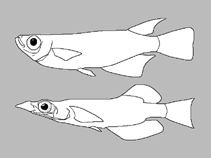
duri punggung lunak (Keseluruhan (total)) : 6 - 7; Sirip dubur lunak: 15 - 17; vertebrata, bertulang belakang: 27 - 29. Oryzias songkhramensis is distinguished from all other congeners by possessing the following combination of characters: anal-fin rays 15 - 16 (modally 16), bony contact organs on the anal-fin rays in males; a relatively anterior dorsal fin origin, opposite anal fin 13 - 14 (modally 14); vertebrae 27 - 29 (modally 28); fourth vertebra without neural prezygapophysis; scale relatively large, cycloid; 26 - 29 (modally 27) in a lateral series, predorsal scale 19 - 21 (modally 21); snout length shorter than eye diameter, snout length 12.9 - 31.2% (mean 21.7%) of HL; eye diameter 35.2 - 53.4% (mean 43.2%) of HL; a black spot at the base of pectoral fin, pectoral fin length 13.1 - 24.9% (mean 19.7%) of SL; length of anal fin base 19.4 - 30.0% (mean 25.6%) of SL; caudal peduncle length 11.3 - 20.3% (mean 16.7%) of SL; caudal fin slightly, rounded, length 3.6 - 3.8 (mean 3.7) in SL, black and pale yellow marginal bands on the dorsal and ventral portions of the caudal fin (Ref. 84389).
Body shape (shape guide): elongated; Cross section: compressed.
The species was collected in clear water from ditches and paddy fields by dip
nets in the Songkhram and Mekong River basins. The area of collection is a small ditch, 3-6 m wide and 0.5 to 2 m deep, Substrate ranges from sand to detritus or mud. Associated species include Trichogaster trichopterus, Trichopsis vittatus, Rasbora rubrodorsalis, Channa striata and Machrobrachium lanchesteri; aquatic plants Nymphaea lotus, Jussiaea repens and Hydrilla verticillata. Water quality in the area: 27.5-28.7 ºC, conductivity 41.5-124.4 μm/l, dissolved oxygen 2.05-3.97 mg/l, pH 7.1-7.9 and salinity 0.1 ppt (Ref. 84389).
Siklus hidup dan perilaku kawin
Kematangan | Reproduksi, perkembang biakan | Pemijahan | telur-telur | Fekunditas | Larva
Magtoon, W., 2010. Oryzias songkhramensis, A New Species of Ricefish (Beloniformes; Adrianichthyidae) from Northeast Thailand and Central Laos. Tropical Natural History 10(1): 107-129. (Ref. 84389)
Status IUCN Red List (Ref. 130435: Version 2025-2 (Global))
ancaman kepada manusia
Harmless
penggunaan manusia
Perikanan: tidak ada kepentingan
Alat, peralatan
laporan khas
muat turun XML
Sumber internet
Estimasi berdasarkan model
Indeks keanekaragaman filogenetik (Acuan
82804): PD
50 = 0.5000 [Uniqueness, from 0.5 = low to 2.0 = high].
Bayesian length-weight: a=0.00479 (0.00190 - 0.01207), b=3.13 (2.91 - 3.35), in cm total length, based on LWR estimates for this (Sub)family-body shape (Ref.
93245).
Tingkat Trofik (Acuan
69278): 3.1 ±0.4 se; based on size and trophs of closest relatives
Kerentanan Penangkapan Ikan (Ref.
59153): Low vulnerability (10 of 100).
🛈