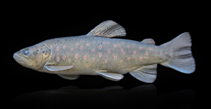
การจำแนกประเภท / ชื่อ
ชื่อสามัญ | ชื่อพ้อง | Catalog of Fishes(สกุล, ชนิด) | ITIS | CoL | WoRMS | Cloffa
>
Salmoniformes (Salmons) >
Salmonidae (Salmonids) > Salmoninae
Etymology: Salmo: Latin, salmo, Plinius = salmon (Ref. 45335); rizeensis: Named for the city and homonymous province of Rize, where it is widely distributed and was first observed; an adjective.
More on authors: Turan, Kottelat & Engin.
สิ่งแวดล้อม : สิ่งแวดล้อม / เขตภูมิอากาศ / ระดับความลึก / ระยะการกระจายสินค้า
นิเวศวิทยา
; น้ำจืด กลุ่มสัตว์หน้าดิน,กลุ่มสัตว์พื้นท้องน้ำ. Subtropical
Asia: headwaters and upper reaches of the streams and rivers entering the Black Sea along its southeastern and southern coasts in Turkey, between Sakarya drainage in the west and Coruh drainage in the east. Apparently present in Georgia.
ความยาวเมื่อครบกำหนดครั้งแรก / ขนาด / น้ำหนัก / อายุ
วัยเจริญพันธุ์: Lm ?, range 11 - ? cm
Max length : 25.0 cm SL เพศผู้/กระเทย; (Ref. 85599)
คำอธิบายสั้นๆ
เครื่องมือที่ใช้ในการแยกชนิดสัตว์,สิ่งมีชีวิตออกจากกัน | สัณฐานวิทยา | ความยาวต่างๆ
ก้านครีบอ่อนที่ก้น: 11; สัตว์มีกระดูกสันหลัง: 55 - 57. Distinguished from all its congeners in Turkey and adjacent areas by the combination of the following characters: small size, maximum length of about 25 cm SL; body brownish in life; black spots on body, small to medium (usually smaller than pupil), ocellated, restricted to back (missing in mid-dorsal area in front of dorsal fin) and to upper part of flank, few (decreasing in number with size); red spots few, small, ocellated, not very conspicuous, usually organized in three or four irregular longitudinal rows on median and lower part of flank, their appearance, size and number not changing with size; head long (27.8-31.1% SL in males, 25.3-27.4 in females), 1.2-1.4 times body depth at dorsal fin origin in male, distinctly sexually dimorphic; maxilla long (length 9.6-12.1 % SL in males, 8.6-9.8 in females), reaching beyond eye in both adults and juveniles, upper edge straight or slightly convex posteriorly in males; adipose fin slender, upper edge straight or very slightly convex anteriorly (Ref. 85599).
Body shape (shape guide): fusiform / normal.
Occurs in small pools of streams with cold, clear and very swift flowing water, with high concentration of dissolved oxygen and substrate consisting of rocks, stones and few pebbles. Spends whole life and spawns in the upper reaches. Does not undertake migration during spawning period. Spawns in September-October. Overwinters into sand or gravel or under rocks and stones in small streams. Seems to stop feeding during winter as all specimens collected in winter had empty stomach (Ref. 85599).
วงจรชีวิตและพฤติกรรมการผสมพันธุ์
วัยเจริญพันธุ์ | การสืบพันธุ์ | การวางไข่ | เซลสืบพันธ์ของเพศเมีย(ไข่) | ความดกของไข่ | ตัวอ่อน
Turan, D., M. Kottelat and S. Engin, 2009. Two new species of trouts, resident and migratory, sympatric in streams of northern Anatolia (Salmoniformes: Salmonidae). Ichthyol. Explor. Freshwat. 20(4):333-364. (Ref. 85599)
สถานะบัญชีแดงของ IUCN (Ref. 130435: Version 2025-2 (Global))
ภัยคุกคามต่อมนุษย์
Harmless
การใช้ของมนุษย์
การประมง: ผลประโยชน์ที่น่าจะเกิดขึ้น
เครื่องมือ
รายงานพิเศษ
ดาวน์โหลด XML
แหล่งที่มาจากอินเตอร์เน็ต
การประมาณค่าตามแบบจำลอง
ดัชนีความหลากหลายทางวิวัฒนาการ (อ้างอิง
82804): PD
50 = 0.5000 [Uniqueness, from 0.5 = low to 2.0 = high].
Bayesian length-weight: a=0.01047 (0.00486 - 0.02255), b=3.03 (2.86 - 3.20), in cm total length, based on LWR estimates for this Genus-body shape (Ref.
93245).
ระดับชั้นอาหาร (อ้างอิง
69278): 3.5 ±0.5 se; based on size and trophs of closest relatives
ความสามารถในการกลับคืนสู่ปกติ (อ้างอิง
120179): ขนาดกลาง, เวลาต่ำสุดที่จะทำให้ประชากรเพิ่มขึ้นเป็น 2 เท่าใช้เวลา 1.4 - 4.4 ปี (Preliminary K or Fecundity.).
ความเสี่ยงต่อการตกปลา (Ref.
59153): Low vulnerability (21 of 100).
🛈