>
Salmoniformes (Salmons) >
Salmonidae (Salmonids) > Salmoninae
Etymology: Salmo: Latin, salmo, Plinius = salmon (Ref. 45335); coruhensis: Name derived from the Çoruh River; an adjective.
More on authors: Turan, Kottelat & Engin.
Lingkungan: lingkungan / zona iklim / kisaran kedalaman / jangkauan distribusi
Ekologi
; air tawar bentopelagis. Subtropical
Asia: streams flowing to the southeastern Black Sea coast in Turkey, from the Yeşilırmak drainage in the west and the Coruh drainage in the east. Expected to be present in Georgia, at least in the lower Coruh.
Panjang pada saat jatuh tempo pertama / Ukuran / Berat / umur
Kematangan: Lm ?, range 16 - ? cm
Max length : 80.0 cm SL jantan/; (Ref. 85599)
deskripsi pendek
Kunci identifiaksi (pengenalan) | Morfologi | Morfometrik
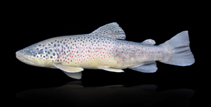
Sirip dubur lunak: 10 - 12; vertebrata, bertulang belakang: 55 - 60. Distinguished from all its congeners in Turkey and adjacent waters by the combination of the following characters: large size, reaches up to at least 80 cm SL; body silvery in life; black spots on body medium to large (equal to or small than pupil), ocellated with circular white ring, scattered on back (sometimes present in predorsal area immediately in front of dorsal fin), middle and upper part of flank, and anterior part of lower half of flank in males larger than 23 cm SL, their number increasing with size; red spots irregularly shaped, surrounded with an irregular white ring, not conspicuous, scattered on a broad longitudinal area along middle of flank, their number increasing with size in specimens larger than 23 cm SL; head somewhat short (length 24.1-28.4% SL in both sexes), approximately 1.0-1.2 times body depth at dorsal-fin origin; maxilla short (length 8.5-10.7% SL in males, 8.5-9.6 in females), reaching beyond eye in specimens larger than 15 cm SL, upper edge convex posteriorly; and adipose fin somewhat deep, upper edge convex anteriorly (Ref. 85599).
Body shape (shape guide): fusiform / normal.
Found in clear and moderately swift flowing water, with a substrate of sand and pebbles. Prefers to inhabit middle stretches of the main branches of rivers and streams, sometime the lower stretches. Also occurs in very short coastal streams (less than 5 km) and usually has not been encountered in intermediate size streams (5-35 km). Moves to the sea or the lower stretches of streams and rivers after spawning, where it stays until about April-May, when temperatures of the water start to rise. Possibly does not go far into the sea, but may stay in river mouths or at sea close to river mouths during winter. Spawns in October-November. Migrates upstreams in small groups of more than 10 individuals and probably comes back after breeding (Ref. 85599).
Siklus hidup dan perilaku kawin
Kematangan | Reproduksi, perkembang biakan | Pemijahan | telur-telur | Fekunditas | Larva
Turan, D., M. Kottelat and S. Engin, 2009. Two new species of trouts, resident and migratory, sympatric in streams of northern Anatolia (Salmoniformes: Salmonidae). Ichthyol. Explor. Freshwat. 20(4):333-364. (Ref. 85599)
Status IUCN Red List (Ref. 130435: Version 2025-2 (Global))
ancaman kepada manusia
Harmless
penggunaan manusia
Perikanan: memiliki potensi kepentingan
Alat, peralatan
laporan khas
muat turun XML
Sumber internet
Estimasi berdasarkan model
Indeks keanekaragaman filogenetik (Acuan
82804): PD
50 = 0.5000 [Uniqueness, from 0.5 = low to 2.0 = high].
Bayesian length-weight: a=0.01047 (0.00486 - 0.02255), b=3.03 (2.86 - 3.20), in cm total length, based on LWR estimates for this Genus-body shape (Ref.
93245).
Tingkat Trofik (Acuan
69278): 3.7 ±0.5 se; based on size and trophs of closest relatives
Daya lenting (Acuan
120179): sangat rendah, Waktu penggandaan populasi minimum lebih dari 14 tahun (Preliminary K or Fecundity.).
Kerentanan Penangkapan Ikan (Ref.
59153): High vulnerability (59 of 100).
🛈