Milieu: milieu / Klimaatzone / Diepte / verspreidingsgebied
Ecologie
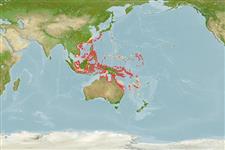
marien rifbewoner; diepte 1 - 20 m (Ref. 1602). Tropical; 32°N - 32°S, 104°E - 173°E
Western Pacific: north to southern Japan, south to New South Wales, Australia and east to Fiji and the Marshall Islands.
Grootte / Gewicht / Leeftijd
Maturiteit: Lm ? range ? - ? cm
Max length : 23.0 cm TL mannelijk / geslacht onbekend; (Ref. 42740)
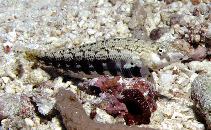
Dorsale stekels (totaal) : 5; Dorsale zachte stralen (totaal) : 21; Anale stekels: 1; Anale zachte stralen: 17. This species is distinguished by the following characters: D V,21; A I,17; 14-16 (rarely 14 or 16) pectoral rays; 44-50 lateral-line scales; 2-3 + 6-8 gill rakers; 5-6 predorsal scales; ctenoid scales on cheek, 7-8 horizontal rows; 10 canine teeth at front of lower jaw, most posterior large and recurved; vomer teeth in a semicircular patch; with palatine teeth; a prominent sharp spine at upper edge of subopercle; posterior edge of preopercle usually irregular to finely serrate while edge of subopercle and upper edge of interopercle sometimes finely serrate, especially in large adults; body depth 4.0-4.35 in SL (23.0-25.0% SL); middle dorsal spine longest, 8.7-10.2% SL; membrane from last dorsal spine joined near base of first soft ray; caudal fin slightly rounded, 20.3-22.8% SL. Best recognized by the series of 10 quadrangular dark brown blotches along its back, progressively shorter posteriorly, each with a darker brown spot at upper corners that merge with small black spots at base of dorsal rays; the first five blotches are joined basally by a wavy dark brown stripe, its upper parts touching lateral line; ten dark brown bars on lower part of body, broadest in the middle, linked in the broad upper part by two horizontal series of dark brown blotches; narrow upper end of each dark bar joining corresponding lower part of above-mentioned wavy stripe, thus isolating a series of ten large roundish pale spots which may contain dark brown blotches or small dark spots; a narrow dark brown bar below middle of eye, sometimes a second less distinct one below front of eye; a dark line from upper lip to eye; a median brown band on upper lip, edged in dark brown; a large black spot basally on dorsal fin between spines; II and V; caudal fin usually yellow or yellowish with numerous very small black spots, a narrow white posterior margin and black submarginal line; males usually with a dark spot of side of upper lip (one female found with one) (Ref. 57562).
Body shape (shape guide): elongated; Cross section: oval.
Found in sheltered bays, harbors and lagoons, but mainly clear water habitats (Ref. 48636). Occurs on sand, rubble, seagrass, or weedy bottoms near shallow reefs (Ref. 42740, 48636). Common in seagrass beds (Ref. 9710). Also Ref. 58652.
Levenscyclus en paargedrag
Maturiteit | Voortplanting | Paaien | Eieren | Fecunditeit | Larven
Randall, J.E., G.R. Allen and R.C. Steene, 1990. Fishes of the Great Barrier Reef and Coral Sea. University of Hawaii Press, Honolulu, Hawaii. 506 p. (Ref. 2334)
Status op de Rode Lijst van het IUCN (Ref. 130435: Version 2025-2 (Global))
Gevaar voor de mens
Harmless
Gebruik door de mens
Visserij: van minder commercieel belang; Aquarium: Publieke aquaria
Tools
Speciale rapporten
Download XML
Internetbronnen
Schattingen op basis van modellen
Gewenste temperatuur (Ref.
123201): 24.7 - 29.3, mean 28.5 °C (based on 2027 cells).
Fylogenetische diversiteitsindex (Ref.
82804): PD
50 = 0.5000 [Uniqueness, from 0.5 = low to 2.0 = high].
Bayesian length-weight: a=0.00776 (0.00475 - 0.01270), b=3.06 (2.92 - 3.20), in cm total length, based on LWR estimates for this species & Genus-body shape (Ref.
93245).
Trofisch niveau (Ref.
69278): 3.0 ±0.4 se; based on diet studies.
Weerstandsvermogen (Ref.
120179): Hoog, minimale populatieverdubbelingstijd minder dan 15 maanden (Fec=100-1,500).
Kwetsbaarheid van de visserij (Ref.
59153): Low vulnerability (13 of 100).
🛈
Voedingsstoffen (Ref.
124155): Calcium = 138 [70, 267] mg/100g; Iron = 1.15 [0.60, 1.98] mg/100g; Protein = 18.2 [15.8, 20.2] %; Omega3 = 0.0819 [, ] g/100g; Selenium = 53.9 [22.5, 127.5] μg/100g; VitaminA = 28 [8, 104] μg/100g; Zinc = 2.12 [1.29, 3.28] mg/100g (wet weight);