التصنيف / الأسماء
الأسماء الشائعة | مرادفات | Catalog of Fishes(جنس, الانواع) | ITIS | CoL | WoRMS | Cloffa
>
Synbranchiformes (Spiny eels) >
Mastacembelidae (Spiny eels)
Etymology: Mastacembelus: Greek, mastax, -agos = bite + Greek, emballo = to throw oneself (Ref. 45335); reygeli: Named for Alain Reygel, artist at the MRAC in Tervuren in appreciation for his numerous beautiful drawings of African fishes.
Eponymy: Alain Marie Robert Godelieve Reygel (d: 1956) is a Belgian artist and scientific illustrator in the Department of Biology at Tervuren (MRAC) (1979–present). [...] (Ref. 128868), visit book page.
البيئة: الوسط / المنطقة المناخية / نطاق العمق / نطاق التوزيع
البيئة
; المياه العذبة قاعية التغذية و المعيشة; نطاق العمق 0 - 10 m (Ref. 82667). Tropical
Africa: endemic to Lake Tanganyika, from Kalemie (Democratic Republic of Congo) to Kigoma (Tanzania) (Ref. 82667).
الحجم / وزن / العمر
النضج: Lm ? range ? - ? cm
Max length : 25.4 cm SL ذكر/ مختلط الجنس; (Ref. 82667)
وصف مختصر
مفاتيح التعريف | الوصف الخارجي | قياسات المظهر الخارجي
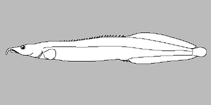
الأشواك الظهرية (المجموع) : 34 - 38; الأشعة الظهرية الناعمة (المجموع) : 54 - 70; شوكة شرجية: 3; أشعه شرجية لينه: 56 - 71; فقرات: 78 - 83. Distinguished from its congeners in Lake Tanganyika by the following characters: short post-anal length 36.6-44.8% SL ( vs. 50.6-60.5 % SL in Mastacembelus ophidium and Mastacembelus polli); brown background color without or with only a limited and scattered dark brown reticulate pattern ( vs. yellow background color with a series of large, saddleshaped, dark brown spots on the dorso-lateral surface of head, body and tail region in Mastacembelus ellipsifer, Mastacembelus plagiostomus and Mastacembelus zebratus); higher number of dorsal spines 34-38 (vs. <30 in Mastacembelus platysoma, Mastacembelus cunningtoni and Mastacembelus moorii and similarly from Mastacembelus micropectus with 26-35 dorsal spines). Additional characters useful to separate from Mastacembelus micropectus include: pectoral-fin length 14.4-25.9% HL (vs. 4.8-22.8% HL); post-anal length 37.5-43.1% SL (vs. 43.9-49.0% HL); brown background color without or with only a limited and scattered dark brown reticulate pattern (vs. a unique color pattern characterized by a light or dark brown background color mostly with numerous tiny yellowish-white spots). Differs from Mastacembelus tanganicae by its lower number of dorsal spines 34-38 (vs. 38-43). In addition, Mastacembelus tanganicae has a unique colour pattern characterized by a
uniform light brown to yellowish background colour with dark brown to black spots on the head, body and tail region forming short zigzag lines on the tail region. This species can also be distinguished by color pattern from Mastacembelus flavidus, which has a uniform light brown to yellowish overall background colour with numerous small, dark brown spots mainly situated on the head, body (above the lateral line) and dorsal fin (Ref. 82667).
Body shape (shape guide): eel-like; Cross section: oval.
Found among rocks at depths from 0 to 10 m (Ref. 82667).
دورة الحياة وسلوك التزاوج
النضج | التكاثر | وضع البيض | بيض | الخصوبة | اليرقات
Vreven, E.J. and J. Snoeks, 2009. A new mastacembelid species from Lake Tanganyika: a case complex evolutionary history. J. Fish Biol. 75(5):1018-1047. (Ref. 82667)
حالة القائمة الحمراء للاتحاد الدولي لحفظ الطبيعة والموارد الطبيعية (Ref. 130435: Version 2025-2 (Global))
استخدامات بشرية
أدوات
تقارير خاصة
تنزيل XML
مصادر علي الأنترنت
تقديرات تستند إلى النماذج
مؤشر التنوع الشُعبي الوراثي (مرجع
82804): PD
50 = 0.5000 [Uniqueness, from 0.5 = low to 2.0 = high].
Bayesian length-weight: a=0.00269 (0.00129 - 0.00562), b=2.94 (2.76 - 3.12), in cm total length, based on LWR estimates for this (Sub)family-body shape (Ref.
93245).
مستوى غذائي (مرجع
69278): 3.8 ±0.6 se; based on size and trophs of closest relatives
المرونه (مرجع
120179): عالي, الحد الزمني الأدني لتضاعف عدد أفراد المجتمع أقل من 15 شهر (Preliminary K or Fecundity.).
ضعف الصيد (Ref.
59153): Low vulnerability (21 of 100).
🛈