Klassifizierung / Names
Namen | Synonyme | Catalog of Fishes(Gattung, Arten) | ITIS | CoL | WoRMS | Cloffa
>
Siluriformes (Catfishes) >
Callichthyidae (Callichthyid armored catfishes) > Corydoradinae
Etymology: urucu: Named for the type locality, the Rio Urucu basin. Originally, the word comes
from the Tupi (‘‘uru-ku’’) for red, derived from the color of the fruit of the ‘‘urucuzeiro’’ (Bixa orellana L.), low tree of the family Bixacea, native from tropical America. A noun in apposition.
Umwelt: Milieu / Klimazone / Tiefenbereich / Verbreitungsgebiet
Ökologie
; süßwasser benthopelagisch. Tropical
South America: Rio Urucu basin, a right-bank tributary of the Rio Solimões in Brazil.
Größe / Gewicht / Alter
Geschlechtsreife: Lm ? range ? - ? cm
Max length : 2.8 cm SL Männchen/unbestimmt; (Ref. 83456)
Kurzbeschreibung
Bestimmungsschlüssel | Morphologie | Morphometrie
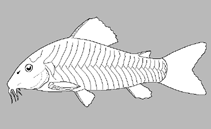
Rückenflossenstacheln (insgesamt) : 1; Rückenflossenweichstrahlen (insgesamt) : 8; Afterflossenweichstrahlen: 8. Distinguished from all its congeners except Corydoras arcuatus, Corydoras narcissus, and Corydoras gracilis, by having a long, arched, dark stripe, running parallel to the dorsal profile and extending at least from the anterior margin of the first dorsolateral body plate to the caudal peduncle. Can be diagnosed from Corydoras arcuatus, Corydoras gracilis, and Corydoras narcissus in having the arc-like stripe terminating posterior to the orbit (vs. extending onto snout). Further differs from Corydoras arcuatus by having fewer free vertebrae (21 vs. 27); lateral profile of the snout distinctly rounded (vs. nearly straight); a greater preadipose distance (84.0-86.7% SL, vs. 82.9-83.8% SL); and the posterior limit of the cleithrum at a vertical through the dorsal-fin spinelet (vs. between the third and fourth dorsal-fin rays); from Corydoras gracilis by having fewer free vertebrae (21 vs. 27); arched stripe extending posteriorly to the base of the lower caudal-fin rays (vs. reaching the base of the upper caudal-fin rays); and the second infraorbital contacting only the sphenotic (vs. contacting both the sphenotic and compound pterotic); from Corydoras narcissus in having the arched stripe extending posteriorly across the lower caudal-fin rays (vs. extending over the lower caudal-fin rays); lateral profile of the snout distinctly rounded (vs. nearly straight); and minute and weak pectoral-spine serrations (vs. large and strong serrations) (Ref. 83456).
Body shape (shape guide): fusiform / normal.
Facultative air-breathing (Ref. 126274); Occurs along semilentic stretches of the shore of a moderately large stream (Igarapé da Onça), about 15 m wide, with sand, clay and leaves on the bottom, in addition to emerged vegetation. Average depth of the stream is 1 m during dry season and 4 m in rainy season (Ref. 83456).
Lebenszyklus und Paarungsverhalten
Geschlechtsreife | Fortpflanzung | Ablaichen | Eier | Fruchtbarkeit | Larven
Britto, M.R., W.B. Wosiacki and L.F.A Montag, 2009. A new species of Corydoradinae catfish (Ostariophysi: Siluriformes: Callichthyidae) from Rio Solimões Basin, Brazil. Copeia 2009(4):684-689. (Ref. 83456)
IUCN Rote Liste Status (Ref. 130435: Version 2025-2 (Global))
Bedrohung für Menschen
Harmless
Nutzung durch Menschen
Tools
Zusatzinformationen
Download XML
Internet Quellen
Schätzungen auf der Grundlage von Modellen
Phylogenetischer Diversitätsindex (Ref.
82804): PD
50 = 0.5000 [Uniqueness, from 0.5 = low to 2.0 = high].
Bayesian length-weight: a=0.01778 (0.00758 - 0.04173), b=3.02 (2.82 - 3.22), in cm total length, based on LWR estimates for this (Sub)family-body shape (Ref.
93245).
Trophische Ebene (Ref.
69278): 3.0 ±0.4 se; based on size and trophs of closest relatives
Anfälligkeit der Fischerei (Ref.
59153): Low vulnerability (10 of 100).
🛈