>
Ovalentaria/misc (Various families in series Ovalentaria) >
Opistognathidae (Jawfishes)
Etymology: Opistognathus: Greek, opisthe = behind + Greek, gnathos = jaw (Ref. 45335); to the very elongate upper jaw of the type species of the genus, Opistognathus nigromarginatus (Ref. 128653); variabilis: Name from Latin 'variabilis', refers to the highly variable color pattern and jaw morphology of this species.
Environnement : milieu / zone climatique / profondeur / gamme de distribution
Écologie
marin pelagic-neritic; profondeur 0 - 37 m (Ref. 81517). Tropical
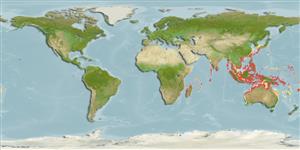
Indo-West Pacific: from the eastern Indian Ocean (Maldive Islands and Sri Lanka)
and throughout most of the central western Pacific, including the Ruykyu Islands and Palau.
Taille / Poids / Âge
Maturité: Lm ? range ? - ? cm
Max length : 9.6 cm SL mâle / non sexé; (Ref. 81517)
Description synthétique
Clés d'identification | Morphologie | Morphométrie
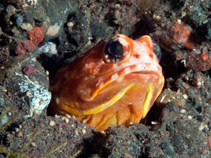
Épines dorsales (Total) : 11; Rayons mous dorsaux (Total) : 14 - 16; Épines anales: 3; Rayons mous anaux: 14 - 16; Vertèbres: 28 - 30. This species is distinguished by the following characters: elongate supramaxilla and posterior end of maxilla produced as a thin flexible lamina, varying from moderate to well-developed; usually a single black stripe (well-developed in fish with elongate jaws but only slightly in those with relatively short jaws) at the inner lining of upper jaw and adjacent membranes; lateral-line ends below verticals between segmented dorsal-fin rays 3-6 (typically fourth or fifth); body with about 68-83 oblique scale rows; caudal vertebrae 19-20 (rarely 20), except only 18 in fish from northern Palawan. There are several color morphs that exist (geographic variations) (Ref. 81517).
Body shape (shape guide): elongated; Cross section: oval.
Found in sand/rubble bottoms in 0-37 m (Ref 90102).
Cycle de vie et comportement reproducteur
Maturité | Reproduction | Frai | Œufs | Fécondité | Larves
Smith-Vaniz, W.F., 2009. Three new species of Indo-Pacific jawfishes (Opistognathus: Opistognathidae), with the posterior end of the upper jaw produced as a thin flexible lamina. aqua, Int. J. Ichthyol. 15(2):69-108. (Ref. 81517)
Statut dans la liste rouge de l'IUCN (Ref. 130435: Version 2025-2 (Global))
Menace pour l'homme
Harmless
Utilisations par l'homme
Outils
Articles particuliers
Télécharger en XML
Sources Internet
Estimations basées sur des modèles
Température préférée (Réf.
123201): 25.3 - 29.3, mean 28.6 °C (based on 2512 cells).
Indice de diversité phylogénétique (Réf.
82804): PD
50 = 0.5000 [Uniqueness, from 0.5 = low to 2.0 = high].
Bayesian length-weight: a=0.00389 (0.00180 - 0.00842), b=3.12 (2.94 - 3.30), in cm total length, based on all LWR estimates for this body shape (Ref.
93245).
Niveau trophique (Réf.
69278): 3.5 ±0.6 se; based on size and trophs of closest relatives
Vulnérabilité de la pêche (Ref.
59153): Low vulnerability (10 of 100).
🛈