Klassifizierung / Names
Namen | Synonyme | Catalog of Fishes(Gattung, Arten) | ITIS | CoL | WoRMS | Cloffa
>
Alepocephaliformes (Slickheads and tubeshoulders) >
Alepocephalidae (Slickheads)
Etymology: Conocara: Latin, conicus = cone + Greek, kara = face (Ref. 45335); paxtoni: Named for John Paxton, who made a large contribution to the study of deep-water fauna of the World Ocean.
Eponymy: Dr John Richard Paxton (d: 1938) is an American-born Australian ichthyologist. [...] (Ref. 128868), visit book page.
Umwelt: Milieu / Klimazone / Tiefenbereich / Verbreitungsgebiet
Ökologie
seewasser bathypelagisch; tiefenbereich ? - 2450 m (Ref. 84725). Deep-water
Southwest Pacific: Tasman Sea.
Größe / Gewicht / Alter
Geschlechtsreife: Lm ? range ? - ? cm
Max length : 38.7 cm SL Männchen/unbestimmt; (Ref. 84725)
Kurzbeschreibung
Bestimmungsschlüssel | Morphologie | Morphometrie
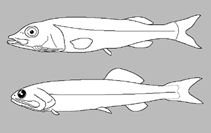
Rückenflossenweichstrahlen (insgesamt) : 20; Afterflossenweichstrahlen: 26; Wirbelzahl: 53. This species is distinguished by the following characteristics: possess a horizontally directed row of modified flattened, ellipsoid in cross section, teeth on the praemaxillare, well developed teeth on the palatinum, and more than 1 row of 'normally developed' teeth on the praemaxillaria and dentalia (near symphysis); relatively large scales on the body, approximately 110 scales in longitudinal row above the lateral line (predorsal 60); gill membrane with 7 rays; first gill slit limited above by a skin fold; epibranchiale of first gill arch with one external gill raker, the inner row of gill rakers at the first gill arch are incomplete (4 at its vertical branch, 4 at horizontal branch, and no angular rakers); vertebrae 21 + 32 = 53; pyloric caeca 5; no cariniform skin fold before dorsal fin insertion; large head, approximately 1/3 of SL; snout length almost equal to orbit diameter; interorbital space relatively narrow (smaller than snout length); upper jaw moderately short, extending slightly behind the vertical of the anterior orbit margin (Ref. 84725).
Body shape (shape guide): elongated.
Lebenszyklus und Paarungsverhalten
Geschlechtsreife | Fortpflanzung | Ablaichen | Eier | Fruchtbarkeit | Larven
Sazonov, Y.I., A. Williams and S.G. Kobyliansky, 2009. Review of fish genus of the genus Conocara (Alepocephalidae) from the Continental slope of Australia and description of a new species C. paxtoni sp. nova. J. Ichthyol. 49(10):852-860. (Ref. 84725)
IUCN Rote Liste Status (Ref. 130435: Version 2025-2 (Global))
Bedrohung für Menschen
Harmless
Nutzung durch Menschen
Tools
Zusatzinformationen
Download XML
Internet Quellen
Schätzungen auf der Grundlage von Modellen
Phylogenetischer Diversitätsindex (Ref.
82804): PD
50 = 0.5010 [Uniqueness, from 0.5 = low to 2.0 = high].
Bayesian length-weight: a=0.00339 (0.00159 - 0.00723), b=3.19 (3.00 - 3.38), in cm total length, based on LWR estimates for this (Sub)family-body shape (Ref.
93245).
Trophische Ebene (Ref.
69278): 3.5 ±0.5 se; based on size and trophs of closest relatives
Widerstandsfähigkeit (Ref.
120179): mittel, Verdopplung der Population dauert 1,4 - 4,4 Jahre. (Preliminary K or Fecundity.).
Anfälligkeit der Fischerei (Ref.
59153): Moderate vulnerability (37 of 100).
🛈