Entorno: milieu / zona climática / rango de profundidad / gama de distribución
Ecología
; agua dulce demersal. Temperate; 5°C - 25°C (Ref. 13614); 53°N - 23°N, 95°E - 143°E
Asia: Honshu, Shikoku and Kyushu in Japan, the Korean Peninsula, Taiwan, China, and Russia.
Longitud en la primera madurez / Tamaño / Peso / Edad
Madurez: Lm 36.0, range 35 - 37 cm
Max length : 130 cm TL macho / no sexado; (Ref. 56557); common length : 37.0 cm SL macho / no sexado; (Ref. 35840); peso máximo publicado: 30.0 kg (Ref. 56557)
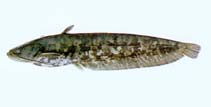
Radios blandos dorsales (total) : 4; Radios blandos anales: 67 - 84. The side of the dorsal is dark grey; white stomach; with irregular white dots on the side. One pair of maxillary barbel, longer than the head; one pair of mandibular barbels, about 1/5-1/3 the length of the maxillary barbel (Ref. 40516).
Body shape (shape guide): elongated; Cross section: oval.
Commercially cultured in Japan. Adults feed on all types of fish (Ref. 41072). Recorded as having been or being farmed in rice fields (Ref. 119549).
Ciclo vital y comportamiento de apareamiento
Madurez | Reproducción | Puesta | Huevos | Fecundidad | Larva
Pairs manifest spawning embrace widely observed in other catfish species (Ref. 37360).
Details of reproductive behaviour from Katano, et al (1988): " A male first energeticaly pursued a female with its head near to the female's belly (chasing) and then began to cling to the female's body from the side, bending its tail or head (clinging). Finally the male enfolded the female's body, with its anus near to the female's (enfolding). In some cases, 2-4 males pursued a single female and two males enfolded a female at the same time. Although no aggressive behaviour was evident between males, it was always the largest male that could almost frequently approach and enfold the female. The mating pair moved a long distance in a ditch, paddy field and/or creek, performing reproductive activities."
The scattering of eggs may reduce the incidence of death of the young.
Kobayakawa, M., 1989. Systematic revision of the catfish genus Silurus, with description of a new species from Thailand and Burma. Jap. J. Ichthyol. 36(2):155-186. (Ref. 9417)
Situación en la Lista Roja de la UICN (Ref. 130435: Version 2025-2 (Global))
Amenaza para el ser humano
Harmless
Usos humanos
Pesquerías: comercial; Acuicultura: comercial; pesca deportiva: si
Herramientas
Informes especiales
Descargar XML
Fuentes de Internet
Estimaciones basadas en modelos
Índice de diversidad filogenética (Referencia
82804): PD
50 = 0.5001 [Uniqueness, from 0.5 = low to 2.0 = high].
Bayesian length-weight: a=0.00589 (0.00502 - 0.00690), b=3.01 (2.96 - 3.06), in cm total length, based on LWR estimates for this species (Ref.
93245).
Nivel trófico (Referencia
69278): 4.4 ±0.3 se; based on diet studies.
Generation time: 10.0 ( na - na) years. Estimated as median ln(3)/K based on 1
growth studies.
Resiliencia (Referencia
120179): Bajo, población duplicada en un tiempo mínimo de 4.5-14 años (tm=4-5; K=0.11).
Vulnerabilidad pesquera (Ref.
59153): High to very high vulnerability (65 of 100).
🛈