This website uses cookies to enhance your browsing experience and ensure the functionality of our site. For more detailed information about the types of cookies we use and how we protect your privacy, please visit our Privacy Information page.
×
Cookie Settings
This website uses different types of cookies to enhance your experience. Please select your preferences below:
> Osteoglossiformes (Bony tongues) > Mormyridae (Elephantfishes)
Etymology: Marcusenius:Becasue of J. Marcusen, author of "Zur Phauna des Schwarzen Meeres", 1867; ichthyologist. Eponymy: Dr Johann Andreas Marcusen (1817–1894) was a Latvian of German descent who was a physician, ichthyologist and zoologist. [...] (Ref. 128868), visit book page. More on author: Fowler.
Africa: coastal rivers draining into the Indian Ocean, ranging between tropical sections of the Limpopo River in the north and the Kosi River system in the south, including the Pongolo River which is the type river (Ref. 75962, 95448).
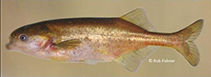
背面の脊椎 (合計) : 0; 背鰭 (合計) : 20 - 23; 肛門の骨: 0; 臀鰭: 26 - 28; 脊つい: 42 - 43. Diagnosis: Marcusenius pongolensis can be distinguished from its congeners by the following characters: a more slender body, elongated, smaller body depth, 19.1-26.0% of standard length; distance from dorsal fin origin to end of caudal peduncle 37.1-39.8% of standard length; distance from anal fin origin to end of caudal peduncle 40.8-42.2% of standard length; and length of anal fin 19.5-21.9% of standard length; all shorter and non-overlapping with Marcusenius krameri, M. caudisquamatus and M. lucombesi (Ref. 95448). Total vertebrae ranges between 42-43 vs. 44 in other species; posterior total gill rakers 13-14 vs. 15 and 17 in M. caudisquamatus and M. krameri, respectively; lateral line scales 70-73; scales around caudal peduncle 16-17; dorsal fin rays 20-23; anal fin rays 26-28 (Ref. 95448). Electric organ discharge (EOD) lacking a weak head-negative pre-potential, in females and juveniles Ndur of short duration, no striking sexual dimorphism in EOD waveform present, but longer EOD duration and statistically significant increase with standard length in males (Ref. 75962).
Body shape (shape guide): elongated; Cross section: compressed.
During the day Marcusenius pongolensis is often encountered below undercut river banks, especially in dense network of tree roots; places where there is a countercurrent seem to be especially attractive; in Swaziland it has been observed high up in river systems with rapid water flow and rocky substrate in Swaziland (Ref. 75962).
Kramer, B., P. Skelton, H. van der Bank and M. Wink, 2007. Allopatric differentiation in the Marcusenius macrolepidotus species complex in southern and eastern Africa: the resurrection of M. pongolensis and M. angolensis, and the description of two new species (Mormyridae, Teleostei). J. Nat. Hist. 41(9-12):647-708. (Ref. 75962)
IUCNのレッドリストの状況は (Ref. 130435: Version 2025-2 (Global))
系統多様性指数 (参照 82804): PD50 = 0.5000 [Uniqueness, from 0.5 = low to 2.0 = high].
Bayesian length-weight: a=0.00562 (0.00248 - 0.01273), b=3.05 (2.85 - 3.25), in cm total length, based on LWR estimates for this (Sub)family-body shape (Ref. 93245).
栄養段階 (参照 69278): 3.1 ±0.4 se; based on size and trophs of closest relatives
回復力 (参照 120179): 高い, 15か月以下の倍増期間の最小個体群 (Preliminary K or Fecundity.).
漁業の脆弱性 (Ref. 59153): Low vulnerability (18 of 100). 🛈