Environnement : milieu / zone climatique / profondeur / gamme de distribution
Écologie
marin récifal; profondeur 0 - 180 m (Ref. 9710), usually 0 - 25 m (Ref. 90102). Tropical; 22°C - 27°C (Ref. 27115); 30°N - 23°S
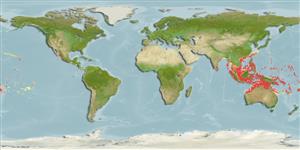
Pacific Ocean: Indonesia to Samoa, north to Ryukyu Islands, south to New Caledonia and the Rowley Shoals in the eastern Indian Ocean (Ref. 1602) and Christmas Island (Ref. 114977).
Taille / Poids / Âge
Maturité: Lm ? range ? - ? cm
Max length : 20.0 cm TL mâle / non sexé; (Ref. 9710)
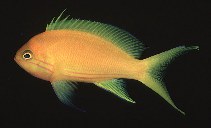
Épines dorsales (Total) : 10; Rayons mous dorsaux (Total) : 16 - 18; Épines anales: 3; Rayons mous anaux: 6 - 7. Highly variable in color and also in the size of the pale blotch (looks blue in natural light). Latter varied from being totally absent to an area almost half the body size, especially when showing nuptial colors. At the Rowley Shoals, off the north-western Australian coast, it only shows the blotch when nuptial (Ref. 48635).
Body shape (shape guide): fusiform / normal; Cross section: compressed.
Aggregations of this species occur a few meters above the edges of current-swept drop-offs (Ref. 4538). Females and males in separate aggregations or mixed sexes (Ref. 48635). Juveniles solitary and remain close to shelter (Ref. 37816). Seldom encountered in the aquarium trade (Ref. 1602).
Cycle de vie et comportement reproducteur
Maturité | Reproduction | Frai | Œufs | Fécondité | Larves
Myers, R.F., 1991. Micronesian reef fishes. Second Ed. Coral Graphics, Barrigada, Guam. 298 p. (Ref. 1602)
Statut dans la liste rouge de l'IUCN (Ref. 130435: Version 2025-2 (Global))
Menace pour l'homme
Harmless
Utilisations par l'homme
Outils
Articles particuliers
Télécharger en XML
Sources Internet
Estimations basées sur des modèles
Température préférée (Réf.
123201): 25.3 - 29, mean 27.9 °C (based on 620 cells).
Indice de diversité phylogénétique (Réf.
82804): PD
50 = 0.5000 [Uniqueness, from 0.5 = low to 2.0 = high].
Bayesian length-weight: a=0.01413 (0.00621 - 0.03212), b=3.00 (2.81 - 3.19), in cm total length, based on LWR estimates for this (Sub)family-body shape (Ref.
93245).
Niveau trophique (Réf.
69278): 3.4 ±0.45 se; based on food items.
Résilience (Réf.
120179): Haut, temps minimum de doublement de population inférieur à 15 mois (Preliminary K or Fecundity.).
Vulnérabilité de la pêche (Ref.
59153): Low vulnerability (10 of 100).
🛈
Nutriments (Ref.
124155): Calcium = 64.1 [37.5, 119.4] mg/100g; Iron = 0.731 [0.400, 1.242] mg/100g; Protein = 18 [16, 20] %; Omega3 = 0.18 [0.11, 0.28] g/100g; Selenium = 35.8 [20.3, 68.0] μg/100g; VitaminA = 177 [62, 569] μg/100g; Zinc = 1.3 [0.9, 1.9] mg/100g (wet weight);