Taxonomic Remarks
This species is placed in the genus EpinephelusBloch, 1793 in Eschmeyer (CofF ver. May 2011: Ref. 86870) as the placement of this species is uncertain in Craig et al. (2007: Ref. 83414).
Environnement : milieu / zone climatique / profondeur / gamme de distribution
Écologie
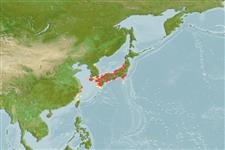
marin récifal; non migrateur; profondeur 5 - 30 m (Ref. 5222). Tropical; 40°N - 24°N, 121°E - 142°E (Ref. 5222)
Northwest Pacific: known with certainty only from Japan, Korea, and China. Reports from other areas appear to be based on misidentifications of Epinephelus octofasciatus.
Taille / Poids / Âge
Maturité: Lm ? range ? - ? cm
Max length : 155 cm TL mâle / non sexé; (Ref. 40637); poids max. publié: 62.8 kg (Ref. 40637)
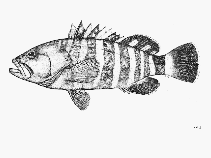
Épines dorsales (Total) : 11; Rayons mous dorsaux (Total) : 14 - 15; Épines anales: 3; Rayons mous anaux: 9. Distinguished by the following characteristics: buff body with 7-8 dark bars; 3 pale interspaces below soft dorsal fin; last dark bar covers most of caudal peduncle and extends to the base of the last 2-3 dorsal fin rays; blackish brown pelvic fin rays; median fins blackish brown distally with narrow pale margin; dark maxillary streak usually hidden by maxilla; pale gill rakers and gill arches, without minute melanophores; depth of body contained 2.5-3.1 times in SL; head length 2.4-2.6 times in SL; distinctly convex interorbital area, convex dorsal head profile; diameter of posterior nostrils of adults 3-4 times bigger than anterior nostrils; angular preopercle, with enlarged serrae at angle; 1-2 small spines anterior to angle at lower edge of preopercle; serrate or smooth lower edge of subopercle and rear edge of interopercle, convex upper edge of operculum; maxilla reaches to below rear half of eye, distinct step on lower edge of maxilla; 2 rows of teeth on midlateral part of lower jaw (Ref. 89707).
Body shape (shape guide): fusiform / normal; Cross section: compressed.
Occurs near shore, including semi-enclosed sea areas in rocky reefs in shallow waters (Ref. 11230). Feeds on fishes and crustaceans (Ref. 89707). Commercially cultured in Japan.
Cycle de vie et comportement reproducteur
Maturité | Reproduction | Frai | Œufs | Fécondité | Larves
Craig, M.T. and P.A. Hastings, 2007. A molecular phylogeny of the groupers of the subfamily Epinephelinae (Serranidae) with revised classification of the epinephelini. Ichthyol. Res. 54:1-17. (Ref. 83414)
Statut dans la liste rouge de l'IUCN (Ref. 130435: Version 2025-2 (Global))
Menace pour l'homme
Harmless
Utilisations par l'homme
Pêcheries: intérêt commercial mineur; Aquaculture: commercial; pêche sportive: oui
Outils
Articles particuliers
Télécharger en XML
Sources Internet
Estimations basées sur des modèles
Température préférée (Réf.
123201): 15.9 - 24.1, mean 20.3 °C (based on 175 cells).
Indice de diversité phylogénétique (Réf.
82804): PD
50 = 0.5000 [Uniqueness, from 0.5 = low to 2.0 = high].
Bayesian length-weight: a=0.00955 (0.00512 - 0.01780), b=3.05 (2.89 - 3.21), in cm total length, based on LWR estimates for this species & Genus-body shape (Ref.
93245).
Niveau trophique (Réf.
69278): 4.0 ±0.66 se; based on food items.
Résilience (Réf.
120179): Très faible, temps minimum de doublement de population supérieur à 14 ans (Preliminary K or Fecundity.).
Vulnérabilité de la pêche (Ref.
59153): Very high vulnerability (90 of 100).
🛈
Nutriments (Ref.
124155): Calcium = 16.4 [10.2, 29.3] mg/100g; Iron = 0.376 [0.201, 0.670] mg/100g; Protein = 18.8 [17.0, 20.5] %; Omega3 = 0.11 [0.07, 0.18] g/100g; Selenium = 41.3 [22.0, 74.4] μg/100g; VitaminA = 54.9 [18.0, 175.6] μg/100g; Zinc = 0.824 [0.572, 1.161] mg/100g (wet weight);