Klassifizierung / Names
Namen | Synonyme | Catalog of Fishes(Gattung, Arten) | ITIS | CoL | WoRMS | Cloffa
>
Beloniformes (Needle fishes) >
Adrianichthyidae (Ricefishes) > Oryziinae
Etymology: Oryzias: Greek, oryza = rice; because of the habitat used by this fish (Ref. 45335); hadiatyae: Name for Renny Kurnia Hadiaty who contributed significantly to the exploration of fish diversity in the Malili Lakes area and discovered this endemic ricefish in remote Lake Masapi.
Eponymy: Dr Renny Kumia Hadiaty (1960–2019) was an Indonesian ichthyologist (see Hadiaty). (Ref. 128868), visit book page.
Umwelt: Milieu / Klimazone / Tiefenbereich / Verbreitungsgebiet
Ökologie
; süßwasser benthopelagisch. Tropical
Asia: Lake Masapi in central Sulawesi, Indonesia.
Größe / Gewicht / Alter
Geschlechtsreife: Lm ? range ? - ? cm
Max length : 4.0 cm SL Männchen/unbestimmt; (Ref. 85098); 4.6 cm SL (female)
Kurzbeschreibung
Bestimmungsschlüssel | Morphologie | Morphometrie
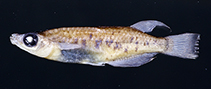
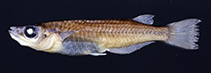
Rückenflossenweichstrahlen (insgesamt) : 8 - 10; Afterflossenweichstrahlen: 19 - 22; Wirbelzahl: 28 - 30. Diagnosed from all species of Adrianichthyidae in Sulawesi by the combination of the following characters: snout with a well marked concavity; a slightly upwards directed mouth; a slender but relatively wide body (body depth 18.2-25.7% SL, body width 10.9-14.5% SL); pelvic
fins with 5-6 rays inserting relatively close to the rear end of the body (prepelvic length >47.7% SL); anal fin with 19-22 rays inserting relatively close to the rear end of the body (preanal length >63% SL); dorsal fin with 8-10 rays inserted above 10-12th anal-fin ray; 28-30 vertebrae; large eyes (30-39.8% HL); scales on the lateral line 27-31, transversal scale rows ½ 10-14; absence of dark blackish, dark bluish, or steel blue body coloration or brilliant red marks in both sexes;
presence of dark brown blotches on the lateral body in adult males; and absence of these blotches in females (Ref. 85098).
Body shape (shape guide): elongated.
Inhabits blackwater lake which is almost circular and only a few meters deep, surrounded by rain forest. The introduced predatory snakehead, Channa striata, occupies the same shallow shoreline habitats of this species and appears likely to cause threats (Ref. 85098).
Lebenszyklus und Paarungsverhalten
Geschlechtsreife | Fortpflanzung | Ablaichen | Eier | Fruchtbarkeit | Larven
Herder, F. and S. Chapuis, 2010. Oryzias hadiatyae, a new species of ricefish (Atherinomorpha: Beloniformes: Adrianichthyidae) endemic to Lake Masapi, Central Sulawesi, Indonesia. Raffles Bull. Zool. 58(2):269-280. (Ref. 85098)
IUCN Rote Liste Status (Ref. 130435: Version 2025-2 (Global))
Bedrohung für Menschen
Harmless
Nutzung durch Menschen
Fischereien: nicht kommerziell
Tools
Zusatzinformationen
Download XML
Internet Quellen
Schätzungen auf der Grundlage von Modellen
Phylogenetischer Diversitätsindex (Ref.
82804): PD
50 = 0.5000 [Uniqueness, from 0.5 = low to 2.0 = high].
Bayesian length-weight: a=0.00479 (0.00190 - 0.01207), b=3.13 (2.91 - 3.35), in cm total length, based on LWR estimates for this (Sub)family-body shape (Ref.
93245).
Trophische Ebene (Ref.
69278): 3.5 ±0.5 se; based on size and trophs of closest relatives
Anfälligkeit der Fischerei (Ref.
59153): Low vulnerability (10 of 100).
🛈