Klassificering / Namn
Populärnamn | synonymer | Catalog of Fishes(Släkte, Arter) | ITIS | CoL | WoRMS | Cloffa
>
Cypriniformes (Carps) >
Psilorhynchidae (Mountain carps)
Etymology: Psilorhynchus: Greek, psilos = hairless + Greek, rhyngchos = snout (Ref. 45335); melissa: The specific name melissa is the classical Greek name of the honey bee, allusion to the black and yellow color pattern of live individuals. A noun in apposition.
Eponymy: Melissa is the classical Greek name of the honey bee, and is here used in allusion to the species’ black and yellow colour pattern. (Ref. 128868), visit book page.
More on authors: Conway & Kottelat.
Miljö: miljö / Klimatzon / djupintervall / distributionsområde
Ekologi
; sötvatten bottenlevande. Tropical
Asia: headwaters of Ann Chaung drainage in Myanmar.
Storlek / Vikt / Ålder
Könsmognad: Lm ? range ? - ? cm
Max length : 5.0 cm SL hane/ej könsbestämd; (Ref. 85100)
Kort beskrivning
Bestämningsnycklar | Morfologi | Morfometri
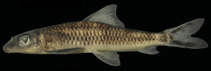
Mjukstrålar i ryggfenan (totalt) : 12; Mjukstrålar i analfenan: 8; Ryggkotor: 34. Shares with its most similar species Psilorhynchus robustus and Psilorhynchus gracilis a dark reticulate pattern over the dorsal and lateral surfaces of the body. Differs from Psilorhynchus robustus and all its congeners by the presence (vs. absence) of a dark band running along the distal edge of the dorsal fin and by the presence of intense (vs. light) scattering of dark melanophores along the anterior edge of the paired fins. Can be further distinguished from Psilorhynchus robustus by its longer, narrower head (head length 22-26% SL vs. 20-22, head width 62-65% HL vs. 67-73), and narrower mouth (mouth width 24-28% HL vs. 28-31), from all other species of the genus, except Psilorhynchus robustus
and Psilorhynchus gracilis, by the presence (vs. absence) of a dark reticulate pattern
over the dorsal and lateral surfaces of the body, and from all other species of the genus, excluding Psilorhynchus robustus, by the presence (vs. absence) of an indistinct lateral streak, formed by a series of small dark spots between the pores of the lateral line canal. Furthermore, can be readily diagnosed from two other congeners (Psilorhynchus breviminor and Psilorhynchus pavimentatus) from Myanmar by having shallower caudal peduncle 7-8 % SL (vs. 9-10 in both Psilorhynchus breviminorand Psilorhynchus pavimentatus), and from Psilorhynchus pavimentatus by having 10 principal rays in the upper caudal fin lobe 10 (vs. 9) (Ref. 85100).
Body shape (shape guide): elongated.
Collected together with Akysis vespertinus, Psilorhynchus pavimentatus and other new fish species from the headwaters of Ann Chaung drainage in Myanmar (Ref. 85100).
Livscykel och parningsbeteende
Könsmognad | Reproduktion | Lek | Ägg | Fekunditet | Larver
Conway, K.W. and M. Kottelat, 2010. Two new species of torrent minnow (Ostariophysi: Psilorhynchidae) from western Myanmar. Raffles Bull. Zool. 58(2):259-267. (Ref. 85100)
Status på IUCN:s rödlista (Ref. 130435: Version 2025-2 (Global))
Hot mot människor
Harmless
Mänskliga användningsområden
Verktyg
Särskilda rapporter
Ladda ner XML
Internet-källor
Uppskattningar baserade på modeller
Index för fylogenetisk mångfald (Ref.
82804): PD
50 = 0.5000 [Uniqueness, from 0.5 = low to 2.0 = high].
Bayesian length-weight: a=0.00417 (0.00178 - 0.00974), b=3.16 (2.95 - 3.37), in cm total length, based on LWR estimates for this (Sub)family-body shape (Ref.
93245).
Trofisk nivå (Ref.
69278): 3.0 ±0.2 se; based on size and trophs of closest relatives
Sårbarhet i fisket (Ref.
59153): Low vulnerability (10 of 100).
🛈