مكسيني (hagfishes) >
Myxiniformes (Hagfishes) >
Myxinidae (Hagfishes) > Eptatretinae
Etymology: Eptatretus: hepta (Gr.), seven; tretos (Gr.), perforated (i.e., with holes), referring to seven gill apertures on what would later be described as Homea banksii (=E. cirrhatus) [range within genus is 6-14 pairs of gill apertures] (See ETYFish); astrolabium: -ium, Latin adjectival suffix: Astrolabe Bay (Papua New Guinea), only known locality, which was named in 1827 by explorer Jules Sébastien César Dumont d’Urville after his ship Astrolabe (See ETYFish).
البيئة: الوسط / المنطقة المناخية / نطاق العمق / نطاق التوزيع
البيئة
بحري قاعية المعيشة; نطاق العمق ? - 500 m (Ref. 85154). Deep-water
Western Pacific: Papua New Guinea.
الحجم / وزن / العمر
النضج: Lm ? range ? - ? cm
Max length : 40.0 cm TL (female)
وصف مختصر
مفاتيح التعريف | الوصف الخارجي | قياسات المظهر الخارجي
This species differs from all its congeners except five Pacific species (Eptatretus carlhubbsi, Eptatretus cirrhatus, Eptatretus goliath, Eptatretus laurahubbsae, Eptatretus strahani) and two Atlantic Ocean species (Eptatretus caribbeaus, Eptatretus menezesi) by having 7 pairs of gill pouches and three-cusp multicusps on the anterior and posterior rows of cusps. It further differs from these congeners by having the following characters: 10 posterior unicusps (vs. 11-13 in E. carlhubbsi, 7-9 in E. cirrhatus, 11-16 in E. laurahubbsae); 52 total cusps (vs. 54-58 in E. caribbeaus, 61-71 in E. carlhubbsi, 61-68 in E. laurahubbsae); 18-19 prebranchial pores (vs. 13-15 in E. caribbeaus, 12-17 in E. carlhubbsi, 14-15 in E. goliath, 14-17 in E. laurahubbsae, 13-17 in E. menezesi, 13-16 in E. strahani); 5 branchial pores (vs. 6-7 or 6-8 for remaining seven-gilled species); 48-49 trunk pores (vs. 60-70 in E. carlhubbsi, 57-58 in E. goliath, 60-67 in E. laurahubbsae); 83-84 total pores (vs. 93-110 in E. carlhubbsi, 92 in E. goliath, 97-105 in E. laurahubbsae, 86-94 in E. menezesi). In addition, these congeners, except E. caribbeaus, have two bilaterally symmetrical nasal-sinus papillae in the dorsal surface of the nasal sinus, while it is absent in E. astrolabium (Ref. 85154).
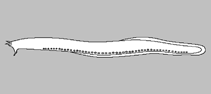
Body shape (shape guide): eel-like.
The observation re the 'silty mud bottom’ were the specimen was taken, was inferred from sediment in traps retrieved. The female holotype with several small, rounded eggs, ca. 2 mm diameter; all eggs in the mesentery, which is attached to the body wall (Ref. 85154). Iteroparous (Ref. 94918).
دورة الحياة وسلوك التزاوج
النضج | التكاثر | وضع البيض | بيض | الخصوبة | اليرقات
Iteroparous (Ref. 94918).
Fernholm, B. and M.M. Mincarone, 2010. A new species of hagfish (Myxinidae: Eptatretus) from Papua New Guinea. J. Fish Biol. 77(4):998-1005. (Ref. 85154)
حالة القائمة الحمراء للاتحاد الدولي لحفظ الطبيعة والموارد الطبيعية (Ref. 130435: Version 2025-2 (Global))
استخدامات بشرية
مصائد: غير ذات اهمية
أدوات
تقارير خاصة
تنزيل XML
مصادر علي الأنترنت
تقديرات تستند إلى النماذج
مؤشر التنوع الشُعبي الوراثي (مرجع
82804): PD
50 = 0.5000 [Uniqueness, from 0.5 = low to 2.0 = high].
Bayesian length-weight: a=0.00204 (0.00094 - 0.00444), b=2.92 (2.72 - 3.12), in cm total length, based on LWR estimates for this (Sub)family-body shape (Ref.
93245).
مستوى غذائي (مرجع
69278): 4.1 ±0.7 se; based on size and trophs of closest relatives
المرونه (مرجع
120179): وسيط, الحد الزمني الأدني لتضاعف عدد أفراد المجتمع 1.4-4.4 سنة (Preliminary K or Fecundity.).
ضعف الصيد (Ref.
59153): Low to moderate vulnerability (30 of 100).
🛈