>
Eupercaria/misc (Various families in series Eupercaria) >
Labridae (Wrasses) > Hypsigenyinae
Etymology: Bodianus: Bodianus after Bodiano or Pudiano, from the Portuguese pudor, meaning modesty (Jordan & Evermann, 1896); bilunulatus: Name formed from the Latin adverb bis, for twice and Latin diminutive noun lunula (luna + ulus) for 'somewhat like the moon'; apparently referring to the lunate caudal fin (double emarginate with filamentous lobes) of the type specimen (Ref. 75973).
More on author: Lacepède.
Περιβάλλον: περιβάλλον / κλιματική ζώνη / εύρος βάθους / εύρος διανομής
Οικολογία
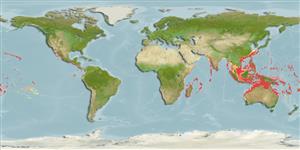
Θαλασσινό(ά) Υφαλόφιλο(α); εύρος βάθους 3 - 160 m (Ref. 9823). Tropical; 30°N - 30°S, 30°E - 134°W
Indo-West Pacific: east coast of Africa to Japan, the Philippines and New Caledonia.
Μέγεθος / Βάρος / Ηλικία
Γεννητική Ωρίμανση: Lm ? range ? - ? cm
Max length : 55.0 cm TL αρσενικό/απροσδιόριστο; (Ref. 4392); μεγ. δημοσιευμένο βάρος: 1.8 kg (Ref. 4887)
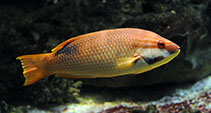
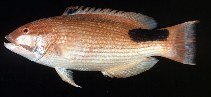
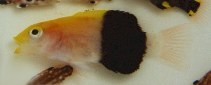
Ραχιαίες άκανθες (συνολικά) : 12; Μαλακές ραχιαίες ακτίνες (συνολικά) : 10; Εδρικές άκανθες: 3; Μαλακές εδρικές ακτίνες: 12. Young easily identified by the unusual coloration. Adults normally have an oval shaped black saddle near the tail, but it may become indistinct in large males (Ref. 48636).
Body shape (shape guide): fusiform / normal.
Adults occur on deep reef slopes rich with invertebrates such as sponges and seawhips, but young adults are occasionally seen much shallower (Ref. 48636). Usually solitary in coral and rocky reefs. Feed mainly on benthic, hard-shelled, invertebrates such as mollusks and crustaceans. Protogynous (Ref. 55080). Oviparous, distinct pairing during breeding (Ref. 205).
Κύκλος ζωής και συμπεριφορά ζευγαρώματος
Γεννητική Ωρίμανση | Αναπαραγωγή | Γεννοβολία | Αβγά | Γονιμότητα | Προνύμφες
Oviparous, distinct pairing during breeding (Ref. 205). Size at sex change: 38.6-40.5 cm L (Ref. 55080).
Westneat, M.W., 2001. Labridae. Wrasses, hogfishes, razorfishes, corises, tuskfishes. p. 3381-3467. In K.E. Carpenter and V. Niem (eds.) FAO species identification guide for fishery purposes. The living marine resources of the Western Central Pacific. Vol. 6. Bony fishes part 4 (Labridae to Latimeriidae), estuarine crocodiles. FAO, Rome. (Ref. 9823)
Κατάσταση Κόκκινου Καταλόγου IUCN (Ref. 130435: Version 2025-2 (Global))
Ανθρώπινες χρήσεις
αλιεία: περιορισμένης εμπορικότητας; αλιεία αναψυχής: ναί; Ενυδρείο: Εμπορικό(ά)
Εργαλεία
Ειδικές εκθέσεις
Λήψη XML
Διαδικτυακές πηγές
Εκτιμήσεις βάσει μοντέλων
Προτιμώμενη θερμοκρασία (Αναφ.
123201): 23.6 - 28.8, mean 27.4 °C (based on 932 cells).
Δείκτης φυλογενετικής ποικιλότητας (Αναφ.
82804): PD
50 = 0.5000 [Uniqueness, from 0.5 = low to 2.0 = high].
Bayesian length-weight: a=0.01047 (0.00493 - 0.02225), b=3.08 (2.90 - 3.26), in cm total length, based on LWR estimates for this Genus-body shape (Ref.
93245).
Τροφικό Επίπεδο (Αναφ.
69278): 3.4 ±0.49 se; based on food items.
Ελαστικότητα (Αναφ.
120179): Μεσαίο(α), ελάχιστος χρόνος για διπλασιασμό πληθυσμού 1,4 - 4,4 έτη (Preliminary K or Fecundity.).
Ευπάθεια στην αλιεία (Ref.
59153): Moderate vulnerability (42 of 100).
🛈
Θρεπτικά συστατικά (Ref.
124155): Calcium = 33.5 [19.8, 51.9] mg/100g; Iron = 0.511 [0.303, 0.904] mg/100g; Protein = 18.5 [15.6, 20.7] %; Omega3 = 0.143 [0.098, 0.211] g/100g; Selenium = 44 [27, 72] μg/100g; VitaminA = 82.7 [26.3, 281.8] μg/100g; Zinc = 1.19 [0.88, 1.84] mg/100g (wet weight);