>
Gobiiformes (Gobies) >
Gobiidae (Gobies) > Gobiinae
Etymology: Bathygobius: Greek, bathys = deep + Latin, gobius = gudgeon (Ref. 45335); antilliensis: Name formed from the proper noun 'Antilles', in reference to the islands of the Antilles, which constitute most of the known range of this species and where it is most abundant.
Milieu: milieu / Klimaatzone / Diepte / verspreidingsgebied
Ecologie
marien benthopelagisch. Tropical
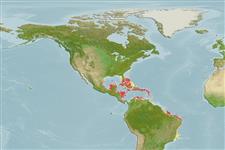
Western Atlantic: insular and continental islands in the Caribbean.
Grootte / Gewicht / Leeftijd
Maturiteit: Lm ? range ? - ? cm
Max length : 9.4 cm SL mannelijk / geslacht onbekend; (Ref. 85559)
Korte beschrijving
Determinatiesleutels | Morfologie | Morfometrie
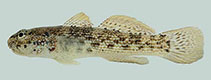
Dorsale stekels (totaal) : 7; Dorsale zachte stralen (totaal) : 9; Anale stekels: 1; Anale zachte stralen: 8. This species is distinguished by the following characters: 18-21 pectoral fin rays; 38-42 lateral scale rows; upper jaw length 9.5-13 % SL, rarely less than 11% SL; predorsal squamation reaching anteriorly beyond vertical through posterior margin of preopercle, often reaching posterior edge of postorbital blotch; first dorsal fin with 1-4 dark blotches on each element forming 1-4 stripes across fin or with one broad, dark brown longitudinal stripe across middle of fin; ventral portion of trunk with 2 rows of markings, upper row with 7-8 dark blotches along lateral midline from beneath pectoral fin to point just anterior to markings on caudal peduncle, lower row typically consisting of 3 conspicuous dark spots - occasionally with diffuse 4th spot beginning beneath ventral portion of pectoral fin and terminating just anterior to origin of anal fin (Ref. 85559).
Body shape (shape guide): elongated.
Collected primarily from reef crests and from shallow tidepools on exposed beaches, where it typically co-occurs with B. mystacium and B. lacertus. A single specimen was collected from a sheltered rocky shoreline near an irrigation canal in Puerto Rico and associated with three species, B. geminatus, B. lacertus, and B. soporator. GenBank accession number for COI sequence of holotype: HM748393 (Ref. 85559).
Levenscyclus en paargedrag
Maturiteit | Voortplanting | Paaien | Eieren | Fecunditeit | Larven
Tornabene, L., C. Baldwin, L.A. Weigt and F. Pezold, 2010. Exploring the diversity of western Atlantic Bathygobius (Teleostei: Gobiidae) with cytochrome c oxidase-I, with descriptions of two new species. aqua, Int. J. Ichthyol. 16(4):141-170. (Ref. 85559)
Status op de Rode Lijst van het IUCN (Ref. 130435: Version 2025-2 (Global))
Gevaar voor de mens
Harmless
Gebruik door de mens
Tools
Speciale rapporten
Download XML
Internetbronnen
Schattingen op basis van modellen
Gewenste temperatuur (Ref.
123201): 26.7 - 28.2, mean 27.5 °C (based on 541 cells).
Fylogenetische diversiteitsindex (Ref.
82804): PD
50 = 0.5000 [Uniqueness, from 0.5 = low to 2.0 = high].
Bayesian length-weight: a=0.00741 (0.00347 - 0.01582), b=3.09 (2.91 - 3.27), in cm total length, based on LWR estimates for this (Sub)family-body shape (Ref.
93245).
Trofisch niveau (Ref.
69278): 3.5 ±0.5 se; based on size and trophs of closest relatives
Kwetsbaarheid van de visserij (Ref.
59153): Low vulnerability (10 of 100).
🛈