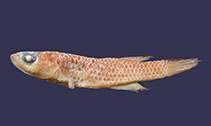
>
Cyprinodontiformes (Rivulines, killifishes and live bearers) >
Nothobranchiidae (African rivulines)
Etymology: Aphyosemion: Greek, aphye, -es, sardine, anchovy + Greek, semeion = mark, signal (Ref. 45335); teugelsi: The species is dedicated to the late Guy Teugels, Royal Museum for Central Africa, Tervuren, Belgium, who died at 50 years of age in 2003; Guy was renowned worldwide for his contribution of the knowledge of African freshwater fishes, especially for his expertise in clariid fishes, his favourite group; he was not only characterized by an impressive scientific productivity but also by his affection for the African continent and its people (Ref. 85863).
Eponymy: Dr Guy G Teugels (1954–2003) was a Belgian ichthyologist. [...] (Ref. 128868), visit book page.
Môi trường: môi trường / vùng khí hậu / Mức độ sâu / phạm vi phân phối
Sinh thái học
; nước ngọt tầng nổi. Tropical
Africa: upper Wamba River basin, Kwango River drainage, in southwest Democratic Republic of Congo (Ref. 85863).
Bộ gần gũi / Khối lượng (Trọng lượng) / Tuổi
Chín muồi sinh dục: Lm ? range ? - ? cm
Max length : 2.4 cm SL con đực/không giới tính; (Ref. 85863)
Mô tả ngắn gọn
Khóa để định loại | Hình thái học | Sinh trắc học
Các tia vây lưng cứng (tổng cộng) : 0; Các vây lưng mềm (tổng cộng) : 10 - 13; Tia cứng vây hậu môn: 0; Tia mềm vây hậu môn: 14 - 15; Động vật có xương sống: 29. Diagnosis: Aphyosemion teugelsi is placed within the Nothobranchiinae and Aphyosemina by the open frontal or nasal neuromast system with two separate grooves and the preopercular neuromast system with 6 pores; a closer relationship with Aphyosemion and not with Fundulopanchax is indicated by the number of circumpeduncular scales, and the more posterior placement of the dorsal fin relative to the anal fin (Ref. 85863). Aphyosemion teugelsi is distinguished from all other species of the subgenus Aphyosemion by the more anterior insertion of the dorsal fin over the anal fin, D/A 6-8 vs. D/A 8-13, and the longer base of the dorsal fin, 13.8-15.3% of standard length vs. 8.6-12.1%; it differs from all species of the subgenus Aphyosemion in having a larger head, head length 29.3-32.0% of standard length vs. 18.9-27.8%, and a larger eye diameter, 9.1-10.3% of standard length vs. 6.9-8.7%; Aphyosemion teugelsi has a higher and more convex back than the species of the subgenus Aphyosemion, dorsal height is 8.0-12.5% of the length of the spinal column vs. 6-10% (Ref. 85863). Males of A. teugelsi are distinguished by members of the subgenus Aphyosemion except A. congicum and A. ferranti by the absence of fin streamers on the edges of the caudal fin; with the exception of A. congicum, A. labarrei, A. ocellatum and A. passaroi, A. teugelsi males can be distinguished from other Aphyosemion males by the dark brown, in live most probably black, margin of all fins vs. fins with a light blue, white, yellow, orange, or reddish margin (Ref. 85863). Males can be distinguished from A. congicum populations from the adjacent Kwango basin by dark fin margins in all fins vs. dark margin only in unpaired fins; dorsal fin with a dark margin and centre with spots vs. almost completely black and, if with spots, only on the fin base; anal fin with broad black margin in A. teugelsi vs. very narrow or no black margin in A. congicum; caudal fin without spots in A. teugelsi and spotted in A. congicum; pectoral fin with black margin in A. teugelsi vs. white, light yellow, or bluish margin in A. congicum (Ref. 85863). Aphyosemion teugelsi can be distinguished from A. labarrei by several characters: flanks with a small number of small light spots, probably red in live, on anterior side in male vs. a dense pattern of large red spots, forming an irregular band in A. labarrei, and by the folling scale counts: lateral line scales 28-29, circumpeduncular scales 11-12 in A. teugelsi vs. 30-32 lateral line and 13-14 circumpeduncular scales in A. labarrei (Ref. 85863). From the two species of the Aphyosemion coeleste species group, A. ocellatum and A. passaroi, A. teugelsi can be separated by the absence of a dark blotch on mid of side slightly posterior to the insertion of pectoral fin vs. presence of a blotch in A. ocellatum, the black margin on upper and lower border of caudal fin vs. completely dark bordered caudal fin in A. passaroi, and from both species by the presence of traces of red dots in nearly regular rows, the dark margin of the pectoral fin, and extended posterior dorsal and anal fin rays vs. nearly complete absence or irregular distribution of red pigmentation on side, no dark pectoral fin borders, and only slightly extended posterior dorsal and anal fin rays from both species (Ref. 85863).
Body shape (shape guide): fusiform / normal.
Vòng đời và hành vi giao phối
Chín muồi sinh dục | Sự tái sinh sản | Đẻ trứng | Các trứng | Sự sinh sản | Ấu trùng
van der Zee, J.R. and R. Sonnenberg, 2010. Aphyosemion teugelsi (Cyprinodontiformes: Nothobranchiidae), a new species from a remote locality in the southern Democratic Republic of the Congo. Zootaxa 2724:58-68. (Ref. 85863)
Tình trạng Sách đỏ IUCN (Ref. 130435: Version 2025-2 (Global))
Mối đe dọa đối với con người
Harmless
Sử dụng của con người
Các công cụ
Báo cáo đặc biệt
Tải xuống XML
Các nguồn internet
Ước tính dựa trên mô hình
Chỉ số đa dạng phát sinh loài (Tài liệu tham khảo
82804): PD
50 = 0.5000 [Uniqueness, from 0.5 = low to 2.0 = high].
Bayesian length-weight: a=0.00603 (0.00250 - 0.01453), b=3.13 (2.93 - 3.33), in cm total length, based on LWR estimates for this (Sub)family-body shape (Ref.
93245).
Mức dinh dưỡng (Tài liệu tham khảo
69278): 3.1 ±0.4 se; based on size and trophs of closest relatives
Sự dễ bị tổn thương của nghề đánh cá (Ref.
59153): Low vulnerability (10 of 100).
🛈