Classification / Noms
Noms communs | Synonymes | Catalog of Fishes(Genre, Espèce) | ITIS | CoL | WoRMS | Cloffa
>
Cichliformes (Cichlids, convict blennies) >
Cichlidae (Cichlids) > Pseudocrenilabrinae
Etymology: Maylandia: In honour of Hans J. Mayland, German ictiologist (Ref. 45335); glaucos: The specific epithet, glaucos, is Greek for bluish gray, in reference to the blue-gray body and fin colouration; it is treated as a noun in apposition (Ref. 86409).
Eponymy: Hans-Joachim Mayland (1928–2004) was a German ichthyologist, aquarist, photographer and writer. [...] (Ref. 128868), visit book page.
Environnement : milieu / zone climatique / profondeur / gamme de distribution
Écologie
; eau douce benthopélagique. Tropical; 12°S - 13°S, 34°E - 35°E
Africa: Lake Malawi in Mozambique (Ref. 86409).
Taille / Poids / Âge
Maturité: Lm ? range ? - ? cm
Max length : 6.9 cm SL mâle / non sexé; (Ref. 86409)
Description synthétique
Clés d'identification | Morphologie | Morphométrie
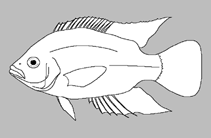
Épines dorsales (Total) : 17 - 19; Rayons mous dorsaux (Total) : 8 - 10; Épines anales: 3; Rayons mous anaux: 7 - 8. Diagnosis: A moderately-sloped head and bicuspid teeth in the outer row of the jaws place this species in Maylandia (Ref. 86409). The absence of a black submarginal band in the dorsal fin in conjunction with a yellow gular region and branchiostegal membranes, and the light-brown coloured females that have yellow fin margins distinguish M. glaucos from other members of Maylandia, except M. chrysomallos and M. benetos; there are generally fewer teeth in the outer row of the lower left jaw, range 14–19, of M. glaucos compared to M. chrysomallos, range 15–25, and more compared to M. benetos, range 9–13 (Ref. 86409). On the basis of colour pattern, females of M. glaucos cannot reliably be distinguished from those of most other members of the Aurora group, but they differ from those of M. xanthos by a shorter lower jaw, 28.8–32.8% of head length vs. 34.6–36.7%; and from those of M. aurora by 8–11 vertical bars below the dorsal fin vs. 6 in M. aurora (Ref. 86409).
Body shape (shape guide): fusiform / normal.
Cycle de vie et comportement reproducteur
Maturité | Reproduction | Frai | Œufs | Fécondité | Larves
Ciccotto, P.J., A. Konings and J.R. Stauffer Jr., 2011. Descriptions of five new species in the genus Metriaclima (Teleostei: Cichlidae) from Lake Malaŵi, Africa. Zootaxa 2738:1-25. (Ref. 86409)
Statut dans la liste rouge de l'IUCN (Ref. 130435: Version 2025-2 (Global))
Menace pour l'homme
Harmless
Utilisations par l'homme
Outils
Articles particuliers
Télécharger en XML
Sources Internet
Estimations basées sur des modèles
Indice de diversité phylogénétique (Réf.
82804): PD
50 = 0.5000 [Uniqueness, from 0.5 = low to 2.0 = high].
Bayesian length-weight: a=0.01445 (0.00671 - 0.03113), b=2.99 (2.82 - 3.16), in cm total length, based on LWR estimates for this (Sub)family-body shape (Ref.
93245).
Niveau trophique (Réf.
69278): 2.4 ±0.1 se; based on size and trophs of closest relatives
Vulnérabilité de la pêche (Ref.
59153): Low vulnerability (10 of 100).
🛈