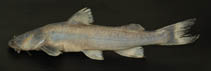
Classificação / Nomes
Nomes comuns | Sinónimos | Catalog of Fishes(Género, Espécies) | ITIS | CoL | WoRMS | Cloffa
>
Siluriformes (Catfishes) >
Sisoridae (Sisorid catfishes) > Sisorinae
Etymology: Glyptothorax: Greek, glyptes = carver + Greek, thorax = breast (Ref. 45335); dikrongensis: Named for its type locality, Dikrong River. An adjective.
Ambiente: milieu / zona climática / intervalo de profundidade / gama de distribuição
Ecologia
; Água doce demersal. Tropical
Asia: Dikrong River in northeastern India.
Tamanho / Peso / Idade
Maturidade: Lm ? range ? - ? cm
Max length : 9.4 cm SL macho/indeterminado; (Ref. 86401)
Descrição breve
Chaves de identificação | Morfologia | Morfometria
Raios anais moles: 10. Distinguished from all other species of the genus Glyptothorax, except Glyptothorax indicus, Glyptothorax rugimentum and Glyptothorax obliquimaculatus, in having an unculiferous patch on the posterior region of the lower lip, in between the inner mandibular-barbel bases, and unculiferous striae of the thoracic adhesive apparatus extending anteriorly onto the gular region. Differs from Glyptothorax indicus by the following combination of characters: equal distance between the posterior end of the pectoral-fin base and the pelvic-fin origin and between the pelvic-fin and the anal-fin origin (vs. distance between posterior end of pectoral-fin base and pelvic-fin origin greater than between pelvic-fin origin and anal-fin origin), and the pelvic-fin origin anterior to or almost at a vertical through the posterior end of the dorsal-fin base (vs. posterior to the dorsal-fin base). Can be separated from Glyptothorax rugimentum by the absence of vertical bars on the body and caudal peduncle, and having a deeper caudal peduncle (8.4-9.2 vs. 6.1-7.6% SL) and a shorter dorsal-fin spine (10.1-11.1 vs. 15.2-18.6% SL); and from Glyptothorax obliquimaculatus in lacking dark, oblique blotches on the body, and in having a shorter dorsal-fin spine (10.1-11.1 vs. 13.4-16.4% SL) (Ref. 86401).
Body shape (shape guide): elongated.
Found in swift, moderate and turbid running water consisting of various substrate such as gravel, cobbles or large boulders, sand and green algae on substratum, in low to moderately deep (30-50 cm) running water (Ref. 86401).
Ciclo de vida e comportamento de acasalamento
Maturidade | Reprodução | Desova | Ovos | Fecundidade | Larvas
Tamang, L. and S. Chaudhry, 2011. Glyptothorax dikrongensis a new species of catfish (Teleostei: Sisoridae) from Arunachal Pradesh, northeastern India. Ichthyol. Res. 58(1):1-9. (Ref. 86401)
Categoria na Lista Vermelha da IUCN (Ref. 130435: Version 2025-2 (Global))
Ameaça para o homem
Harmless
Utilização humana
Pescarias: sem interesse
Ferramentas
Relatórios especiais
Descarregue XML
Fontes da internet
Estimativas baseadas em modelos
Índice de diversidade filogenética (Ref.
82804): PD
50 = 0.5000 [Uniqueness, from 0.5 = low to 2.0 = high].
Bayesian length-weight: a=0.00794 (0.00365 - 0.01726), b=3.02 (2.85 - 3.19), in cm total length, based on LWR estimates for this Genus-body shape (Ref.
93245).
Nível Trófico (Ref.
69278): 3.2 ±0.4 se; based on size and trophs of closest relatives
Vulnerabilidade da pesca (Ref.
59153): Low vulnerability (10 of 100).
🛈