Classificatie / Namen
Lokale namen | Synoniemen | Catalog of Fishes(Genus, Soort(en)) | ITIS | CoL | WoRMS | Cloffa
>
Cichliformes (Cichlids, convict blennies) >
Cichlidae (Cichlids) > Pseudocrenilabrinae
Etymology: Sarotherodon: Greek, saros, -ou = sawdust + Greek, ther = animal * Greek, odous = teeth (Ref. 45335); lamprechti: Named for Jürg Lamprecht (1941–2000), who worked for his PhD on haplotilapiine cichlids, and who supported UKS as a mentor, teacher and friend at the Max-Planck-Institut (Seewiesen), and DN as a teacher (Ref. 86429).
Eponymy: Jürg Lamprecht (1941–2000) was a Swiss fish behaviourist, researcher and teacher. [...] (Ref. 128868), visit book page.
Milieu: milieu / Klimaatzone / Diepte / verspreidingsgebied
Ecologie
; zoet water pelagisch. Tropical; 6°N - 5°N, 8°E - 9°E
Africa: Lake Ejagham in Cameroon (Ref. 86429).
Grootte / Gewicht / Leeftijd
Maturiteit: Lm ? range ? - ? cm
Max length : 10.5 cm SL mannelijk / geslacht onbekend; (Ref. 86429)
Korte beschrijving
Determinatiesleutels | Morfologie | Morfometrie
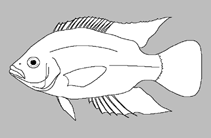
Dorsale stekels (totaal) : 15 - 16; Dorsale zachte stralen (totaal) : 12 - 14; Anale stekels: 3; Anale zachte stralen: 10 - 12. Diagnosis: Sarotherodon lamprechti is distinguished from all congeners by a lack of scales over the pectoral-fin base (Ref. 86429). Further distinguished from its sympatric sibling species, S. knauerae, and other S. galilaeus populations, by a combination of a prognathous lower jaw and an elongate ventral keel on the lower pharyngeal jaw; it also differs from the sympatric S. knauerae in a lower gill raker number, 20–25 vs. 24–30; longer pelvic fins reaching to or beyond first anal fin-spine, vs. not reaching beyond anus; from S. knauerae and other S. galilaeus populations and subspecies by long pectorals reaching the last anal fin-spine, vs. ending either in front of or at first anal fin-spine; upper lip large and prominent, upper lip length 22.5–28.4% of head length vs. 19.1– 25.4% in S. knauerae, 19.3–23.6% in neighbouring riverine S. galilaeus, 18.9–24.2% in S. g. borkuanus and 6.9–12.3% in S. g. multifasciatus; it differs from S. g. sanagaensis in lower preorbital depth, 16.3–25.2% of standard length vs. 25.0–27.8%; and from S. g. boulengeri in lower body depth, 36.3–40.4% of standard length vs. 44.5–50.0% (Ref. 86429). Finally it differs from phenotypically similar S. caroli and S. linnellii in lower gill raker number, 20–25 vs. 18–20 and 15–18; and from other Barombi Mbo Sarotherodon in higher number of dorsal fin-rays, 13–15 vs. 10–12 (Ref. 86429).
Body shape (shape guide): short and / or deep.
A pelagic phytoplanctivore found in Lake Ejagham; common in large swarms in open water, or on the lake bottom in deeper zones during the main breeding season (Ref. 86429). Nuptial males excavate shallow pits with narrow rims over sand, which serve as courtship territories and spawning sites; bower diameter ranges from 16-47 cm; larger bowers appear to be more common in deeper sandy areas, 3-9 m deep, where the majority of bowers are concentrated often in close proximity; neighbouring males often engage in agonistic interactions between bowers; only rarely, and only in shallow water less than 3 m deep, males in full nuptial colouration can be observed without bowers, but over natural depressions above fallen trees or flat stones (Ref. 86429). This species is a female mouth-brooder (Ref. 86429).
pelagic phytoplanctivore found in open water or on lake bottom in deeper zones; nuptial males excavate shallow pits with narrow rims over sand which serve as courtship territories and spawning sites; neighbouring males often engage in agonistic interactions between bowers; female mouth-brooder; reproduction takes place in the rainy season (August/September) (Ref. 86429).
Levenscyclus en paargedrag
Maturiteit | Voortplanting | Paaien | Eieren | Fecunditeit | Larven
Nuptial males excavate shallow pits with narrow rims over sand, which serve as courtship territories and spawning sites; bower diameter ranges from 16-47 cm; larger bowers appear to be more common in deeper sandy areas, 3-9 m deep, where the majority of bowers are concentrated often in close proximity; neighbouring males often engage in agonistic interactions between bowers; only rarely, and only in shallow water less than 3 m deep, males in full nuptial colouration can be observed without bowers, but over natural depressions above fallen trees or flat stones (Ref. 86429). This species is a female mouth-brooder (Ref. 86429).
Neumann, D., M.L.J. Stiassny and U.K. Schliewen, 2011. Two new sympatric Sarotherodon species (Pisces: Cichlidae) endemic to Lake Ejagham, Cameroon, west-central Africa, with comments on the Sarotherodon galilaeus species complex. Zootaxa 2765:1-20 (Ref. 86429)
Status op de Rode Lijst van het IUCN (Ref. 130435: Version 2025-2 (Global))
Gevaar voor de mens
Harmless
Gebruik door de mens
Tools
Speciale rapporten
Download XML
Internetbronnen
Schattingen op basis van modellen
Fylogenetische diversiteitsindex (Ref.
82804): PD
50 = 0.5001 [Uniqueness, from 0.5 = low to 2.0 = high].
Bayesian length-weight: a=0.01905 (0.00846 - 0.04293), b=3.01 (2.82 - 3.20), in cm total length, based on LWR estimates for this (Sub)family-body shape (Ref.
93245).
Trofisch niveau (Ref.
69278): 2.4 ±0.2 se; based on size and trophs of closest relatives
Kwetsbaarheid van de visserij (Ref.
59153): Low vulnerability (10 of 100).
🛈