>
Perciformes/Scorpaenoidei (Scorpionfishes) >
Scorpaenidae (Scorpionfishes or rockfishes) > Scorpaeninae
Etymology: Scorpaenopsis: Latin, scorpaena = a kind of fish, 1706 + Greek, opsis = appearance (Ref. 45335); crenulata: Name from Latin meaning serrated, referring to the serrated spines on the dorsal part of the head of the new species.
Environnement : milieu / zone climatique / profondeur / gamme de distribution
Écologie
marin benthopélagique. Tropical
Southwestern Pacific: Wallis and Futuna Islands.
Taille / Poids / Âge
Maturité: Lm ? range ? - ? cm
Max length : 4.9 cm SL mâle / non sexé; (Ref. 86405)
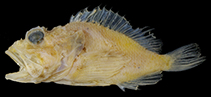
Épines dorsales (Total) : 12; Rayons mous dorsaux (Total) : 9; Épines anales: 3; Rayons mous anaux: 5. This species is distinguished by the following characters: 17 pectoral-fin rays; 37 scale rows in longitudinal series; 19 pored lateral-line scales; posterior margin of maxilla extending well beyond a vertical through posterior margin of orbit; an additional spine arising from a low median ridge of anterior lacrimal spine; posterior lacrimal spine divided into 2 spinous points; poorly developed interorbital ridges, covered with skin (not visible if skin is not removed); upper opercular spine divided into three spinous points; postocular, tympanic, nuchal, pterotic, posttemporal, and supracleithral spines serrated; extremely deep occipital pit, its depth greater than pupil diameter; space between ventral margin of orbit and suborbital ridge broad, its distance 4.1% SL ; extremely deep suborbital pit, its depth subequal to pupil diameter; a pair of pores behind a symphysial knob on lower jaw; nape and anterior body not highly arched; a narrow interorbital space, its width (7.2% SL ) less than orbit diameter; a large head, its length 50.5% SL ; short snout, length 13.7% SL ; large eye, orbit diameter 11.5% SL ; inner surface of pectoral fin with a poorly defined, large black blotch distally between third and seventh rays; a large black blotch on the upper one-third of pectoral-fin axil (Ref. 56405).
Body shape (shape guide): short and / or deep; Cross section: compressed.
Cycle de vie et comportement reproducteur
Maturité | Reproduction | Frai | Œufs | Fécondité | Larves
Motomura, H. and R. Causse, 2011. A new deepwater scorpionfish of the genus Scorpaenopsis (Scorpaenidae) from Wallis and Futuna Islands, southwestern Pacific Ocean. Bull. Mar. Sci. 87(1):45-53. (Ref. 86405)
Statut dans la liste rouge de l'IUCN (Ref. 130435: Version 2025-2 (Global))
Menace pour l'homme
Harmless
Utilisations par l'homme
Outils
Articles particuliers
Télécharger en XML
Sources Internet
Estimations basées sur des modèles
Indice de diversité phylogénétique (Réf.
82804): PD
50 = 0.5000 [Uniqueness, from 0.5 = low to 2.0 = high].
Bayesian length-weight: a=0.01622 (0.00658 - 0.03999), b=3.07 (2.85 - 3.29), in cm total length, based on LWR estimates for this (Sub)family-body shape (Ref.
93245).
Niveau trophique (Réf.
69278): 3.5 ±0.6 se; based on size and trophs of closest relatives
Vulnérabilité de la pêche (Ref.
59153): Low vulnerability (10 of 100).
🛈