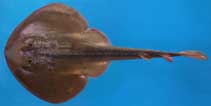
Elasmobranchi (squali e razze) (sharks and rays) >
Torpediniformes (Electric rays) >
Platyrhinidae (Fanrays)
Etymology: Platyrhina: Greek, platys = flat + Greek, rhinos = nose. It is the same voice used for the Mammalian division made in Primates (Ref. 45335); hyugaensis: Named for the belief that it is endemic and common to the Hyuga Nada Sea.
Ambiente: milieu / zona climatica / distribuzione batimetrica / gamma di distribuzione
Ecologia
marino pelagic-neritic; distribuzione batimetrica 1 - 50 m (Ref. 86259). Temperate; 30°N - 34°N, 127°E - 140°E (Ref. 114953)
North-West Pacific: endemic to southern Japan.
Dimensione / Peso / Età
Maturità: Lm ? range ? - ? cm
Max length : 43.1 cm TL (female)
Breve descrizione
Chiavi di identificazione | Morfologia | Morfometria
This species is distinguished from its congeners by the following set of characters: a row of thorns (strongly hooked) on mid-dorsum of tail; a pair of thorns on anterior part of scapular region (apparent to touch in smallest specimen; 161 mm TL); thorns on orbital, nape and scapular regions not encircled by light yellow or white pigment; dorsal surface covered with minute dermal denticles of uniform size and shape, no obvious larger dermal denticles (smooth to touch) (Ref. 86259).
Body shape (shape guide): other; Cross section: flattened.
A benthic ray species that is narrow-ranging (Ref. 114953). According to local divers in Miyazaki, this species often occurs on very shallow sandy bottoms, at depths as shallow as ca. 1 m, in the summer season off the Nichinan Coast, Miyazaki. It is frequently captured by set net within a depth of ca. 50 m from early spring (March) to autumn (November). It was observed by a local fisherman and a fish merchant (pers.comm.), that this species was not included in almost daily set net catches (depth ca. 8-50 m) from November to March in 2007-2008 in northern Miyazaki (Kadokawa Bay) and southern Miyazaki (Meitsu, Nichinan Coast) which indicate that the species avoids lower sea temperatures in the winter season (Ref. 86259). Males mature from ca. 20 cm TL (Ref. 114953).
Ciclo vitale e comportamento di accoppiamento
Maturità | Riproduzione | Deposizione | Uova | Fecondità | Larve
Iwatsuki, Y., K. Miyamoto, K. Nakaya and J. Zhang, 2011. A review of the genus Platyrhina (Chondrichthys: Platyrhinidae) from the northwestern Pacific, with descriptions of two new species. Zootaxa 2738:26-40. (Ref. 86259)
Stato della Lista Rossa IUCN (Ref. 130435: Version 2025-2 (Global))
Minaccia per l'uomo
Harmless
Usi umani
Strumenti
Rapporti speciali
Scarica XML
Fonti Internet
Stime basate su modelli
Indice di diversità filogenetica (Fonte Biblio.
82804): PD
50 = 0.5938 [Uniqueness, from 0.5 = low to 2.0 = high].
Bayesian length-weight: a=0.01000 (0.00244 - 0.04107), b=3.04 (2.81 - 3.27), in cm total length, based on all LWR estimates for this body shape (Ref.
93245).
Livello trofico (Fonte Biblio.
69278): 3.4 ±0.4 se; based on size and trophs of closest relatives
Vulnerabilità della pesca (Ref.
59153): Low to moderate vulnerability (33 of 100).
🛈