Classificação / Nomes
Nomes comuns | Sinónimos | Catalog of Fishes(Género, Espécies) | ITIS | CoL | WoRMS | Cloffa
>
Cichliformes (Cichlids, convict blennies) >
Cichlidae (Cichlids) > Pseudocrenilabrinae
Etymology: Haplochromis: Greek, Haploos = single + Greek, chromis = a fish, perhaps a perch (Ref. 45335); bwathondii: This species is named in honour of Prof. Dr. Philip O.J. Bwathondi, Director General of the Tanzania Fisheries Research Institute (TAFIRI) from August 1983 until the end of 2006; during this period Prof. Bwathondi supported the research of the Haplochromis Ecology Survey Team (HEST) in many ways (Ref. 85523).
Eponymy: Professor Dr Philip O J Bwathondi was Director General of the Tanzania Fisheries Research Institute (TAFIRI) (1983–2006). During this period, he supported the research of the Haplochromis Ecology Survey Team (HEST) in many ways. (Ref. 128868), visit book page.
Ambiente: milieu / zona climática / intervalo de profundidade / gama de distribuição
Ecologia
; Água doce pelágico(a,os,as). Tropical
Africa: Lake Victoria (Ref. 85523).
Tamanho / Peso / Idade
Maturidade: Lm ? range ? - ? cm
Max length : 8.2 cm SL macho/indeterminado; (Ref. 85523)
Descrição breve
Chaves de identificação | Morfologia | Morfometria
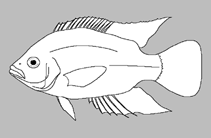
Vértebras: 28 - 30. Diagnosis: Haplochromis bwathondii is a small sized (less than 9 cm standard length), micrognathic species with a normal to relatively slender body outline, body depth 29.7-35.7% of standard length; with bicuspid and tricuspid teeth in the oral jaws and a moderately curved dorsal head profile; it has a melanin pattern of dusky, interrupted, longitudinal bands and vertical bars, producing a so-called 'chess board pattern'; this pattern also occurs in several oral shelling molluscivores, insectivores and algae scrapers, but these species generally are larger, have a strongly curved dorsal head profile and a lower jaw length/width ratio of less than 1.5, whereas in H. bwathondii it ranges from 2.0 to 2.8 (Ref. 85523). Haplochromis bwathondii differs from other small species with a 'chess board pattern' and a lower jaw length/width ratio of more than 1.5, H. sphex and H. sauvagei, in live colouration of sexually active males, by having red in the rostral part of the body; further, it differs from H. sphex by having a deeper body and a larger eye (Ref. 85523). On first impression the colours of sexually active males of H. bwathondii and H. sauvagei look alike; however males of H. bwathondii have a less distinct 'chess board pattern', are less yellow and have a silvery iridescent area on each scale, giving them a silvery appearance; furthermore H. bwathondii has a larger eye, thinner lips, a narrower lower jaw and less stout teeth with a relatively larger flange than H. sauvagei (Ref. 85523).
Body shape (shape guide): fusiform / normal.
Found in the sub-littoral areas of the Mwanza Gulf, over mud bottoms; it is a mainly pelagic species (Ref. 85523). Before the ecological changes in Lake Victoria, this species fed mainly on Cyanophyta, both during day and night; Aulacoseira and occasionally other small diatoms such as Nitzschia were also consumed, as well as adult insects and insect pupae from the water surface (Ref. 85523). This species is a female mouth brooder that spawns the whole year (Ref. 85523).
Ciclo de vida e comportamento de acasalamento
Maturidade | Reprodução | Desova | Ovos | Fecundidade | Larvas
This species is a female mouth brooder that spawns the whole year (Ref. 85523).
de Zeeuw, M.P., M. Mietes, P. Niemantsverdriet, S. ter Huurne and F. Witte, 2010. Seven new species of detritivorous and phytoplanktivorous haplochromines from Lake Victoria. Zool. Meded. Leiden 84:201-250. (Ref. 85523)
Categoria na Lista Vermelha da IUCN (Ref. 130435: Version 2025-2 (Global))
Ameaça para o homem
Harmless
Utilização humana
Ferramentas
Relatórios especiais
Descarregue XML
Fontes da internet
Estimativas baseadas em modelos
Índice de diversidade filogenética (Ref.
82804): PD
50 = 0.5000 [Uniqueness, from 0.5 = low to 2.0 = high].
Bayesian length-weight: a=0.01445 (0.00671 - 0.03113), b=2.99 (2.82 - 3.16), in cm total length, based on LWR estimates for this (Sub)family-body shape (Ref.
93245).
Nível Trófico (Ref.
69278): 3.3 ±0.4 se; based on size and trophs of closest relatives
Vulnerabilidade da pesca (Ref.
59153): Low vulnerability (10 of 100).
🛈