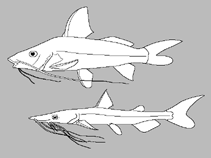
Classification / Noms
Noms communs | Synonymes | Catalog of Fishes(Genre, Espèce) | ITIS | CoL | WoRMS | Cloffa
>
Siluriformes (Catfishes) >
Pimelodidae (Long-whiskered catfishes)
Etymology: Pimelodus: Greek, pimele = fat + Greek, odous = teeth (Ref. 45335); multicratifer: Name from Latin 'multi' for many, numerous; and the Latin noun 'cratis' meaning rake; referring to the gill rakers; and 'fer', from Latin verb 'fero', meaning 'to bear, carry, support, lift, hold, take up'.
Environnement : milieu / zone climatique / profondeur / gamme de distribution
Écologie
; eau douce benthopélagique. Tropical
South America: Brazil.
Taille / Poids / Âge
Maturité: Lm ? range ? - ? cm
Max length : 19.8 cm SL mâle / non sexé; (Ref. 86673)
Description synthétique
Clés d'identification | Morphologie | Morphométrie
Vertèbres: 40. This species is distinguished and differs from its congeners by the following characters: gill rakers on the first branchial arch 26-30 (vs. 18-27); sides of trunk with 3-6 rows of dark spots which are regularly or irregularly scattered and several small dark spots irregularly scattered on the dorsal surface of head, supraoccipital process, and sometimes on the dorsal and caudal fins; striated lips; maxillary barbels reaching between posterior tip of the pelvic-fin rays and posterior tip of the middle caudal-fin rays (Ref. 86673).
This species is widepread throughout the rio Ribeira de Iguape drainage, ranging from the altitudes of 3 m above sea level at the rios Pariquera-Açu and Pariquera-Mirim in the lower stretch of the rio Ribeira de Iguape, to 250 m above sea level at the rio Catas Altas in the high stretch of the river basin. It was found mainly in the large rivers like Ribeira de Iguape, Catas Altas, Pariquera-Mirim and Turvo; rivers of the high stretch have clear water running over rocks and sand; rivers of the low stretch have a turbid water, and in some case, acid black water like the rio Momuna, at the sandbank forest near the mouth of the rio Ribeira de Iguape into the sea. At the type locality, this species occurs syntopically with the following species: Cyphocharax santacatarinae, Hoplias malabaricus, Oligosarcus hepsetus, Hoplosternum littorale and Crenicichla iguapina (Ref. 86673).
Cycle de vie et comportement reproducteur
Maturité | Reproduction | Frai | Œufs | Fécondité | Larves
Ribeiro, F.R.V., C.A.S. de Lucena and O.T. Oyakawa, 2011. A new species of Pimelodus La Cépède, 1803 (Siluriformes: Pimelodidae) from rio Ribeira de Iguape basin, Brazil. Neotrop. Ichthyol. 9(1):127-134. (Ref. 86673)
Statut dans la liste rouge de l'IUCN (Ref. 130435: Version 2025-2 (Global))
Menace pour l'homme
Harmless
Utilisations par l'homme
Pêcheries: sans intérêt
Outils
Articles particuliers
Télécharger en XML
Sources Internet
Estimations basées sur des modèles
Indice de diversité phylogénétique (Réf.
82804): PD
50 = 0.5000 [Uniqueness, from 0.5 = low to 2.0 = high].
Bayesian length-weight: a=0.00692 (0.00304 - 0.01573), b=3.10 (2.92 - 3.28), in cm total length, based on LWR estimates for this Genus-body shape (Ref.
93245).
Niveau trophique (Réf.
69278): 3.3 ±0.5 se; based on size and trophs of closest relatives
Résilience (Réf.
120179): Haut, temps minimum de doublement de population inférieur à 15 mois (Preliminary K or Fecundity.).
Vulnérabilité de la pêche (Ref.
59153): Low vulnerability (14 of 100).
🛈