Entorno: milieu / zona climática / rango de profundidad / gama de distribución
Ecología
marino; salobre demersal; rango de profundidad 19 - 146 m (Ref. 57178). Tropical
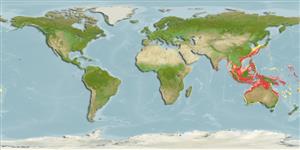
Indo-Pacific: as far north as Japan, southward to the Arafura Sea (Ref. 9819) and north Australia and westward to Madras, India.
Tamaño / Peso / Edad
Madurez: Lm ? range ? - ? cm
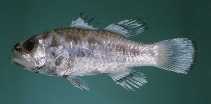
Max length : 14.0 cm SL macho / no sexado; (Ref. 48635)
Nocturnal species. Occurs inshore over soft bottom (Ref. 7300). Lives in holes in the mud during the day. Usually trawled near river mouths (Ref. 48635).
Ciclo vital y comportamiento de apareamiento
Madurez | Reproducción | Puesta | Huevos | Fecundidad | Larva
Mouthbrooders (Ref. 240). Distinct pairing during courtship and spawning (Ref. 205).
Weber, M. and L.F. de Beaufort, 1929. The fishes of the Indo-Australian Archipelago. V. Anacanthini, Allotriognathi, Heterostomata, Berycomorphi, Percomorphi: Kuhliidae, Apogonidae, Plesiopidae, Pseudoplesiopidae, Priacanthidae, Centropomidae. Leiden (The Netherlands): E.J. Brill, 5:xiv, 458 p. (Ref. 4900)
Situación en la Lista Roja de la UICN (Ref. 130435: Version 2025-2 (Global))
Amenaza para el ser humano
Harmless
Usos humanos
Herramientas
Informes especiales
Descargar XML
Fuentes de Internet
Estimaciones basadas en modelos
Temperatura preferida (Referencia
123201): 23.4 - 28.5, mean 27.3 °C (based on 836 cells).
Índice de diversidad filogenética (Referencia
82804): PD
50 = 0.5000 [Uniqueness, from 0.5 = low to 2.0 = high].
Bayesian length-weight: a=0.01000 (0.00428 - 0.02336), b=3.07 (2.89 - 3.25), in cm total length, based on LWR estimates for this Genus-body shape (Ref.
93245).
Nivel trófico (Referencia
69278): 3.6 ±0.6 se; based on size and trophs of closest relatives
Resiliencia (Referencia
120179): Alto, población duplicada en un tiempo mínimo inferior a 15 meses (Preliminary K or Fecundity.).
Vulnerabilidad pesquera (Ref.
59153): Low vulnerability (10 of 100).
🛈