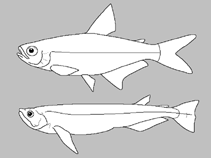
Clasificación / Nombres
Nombres comunes | Sinónimos | Catalog of Fishes(Género, Especie) | ITIS | CoL | WoRMS | Cloffa
>
Characiformes (Characins) >
Characidae (Characins; tetras) > Tetragonopterinae
Etymology: Tetragonopterus: Name from Greek words: 'Tetra' meaning four; 'gonia' meaning angle; 'pteron' for fin; referring to the evident tetragonal shape of the body (Ref. 124043); carvalhoi: Named for Marcelo Rodrigues de Carvalho (USP), the leader of the expedition to rio Jari which resulted in the collection of this new species and in recognition of his contributions to our knowledge of the Neotropical ichthyology.
Eponymy: Dr Marcelo Rodrigues de Carvalho works at the Departamento de Zoologia, Instituto de Biociências, Universidade de São Paulo where he is a professor. [...] (Ref. 128868), visit book page.
Entorno: milieu / zona climática / rango de profundidad / gama de distribución
Ecología
; agua dulce bentopelágico. Tropical
South America: Brazil.
Tamaño / Peso / Edad
Madurez: Lm ? range ? - ? cm
Max length : 6.5 cm SL macho / no sexado; (Ref. 96868)
Radios blandos dorsales (total) : 9; Radios blandos anales: 29 - 34; Vértebra: 28. This species is distinguished from its congeners by having a lozenge-shaped spot on the caudal peduncle (vs. rounded to square spot on the other species); differs from T. anostomus, T. denticulatus, T. juruena, T. kuluene by the number of principal teeth in dentary 4 (vs. 5-6) and with larger and more robust teeth (vs. thinner and sharper teeth); differs from T. anostomus, T. araguaiensis by the number of gill-rakers on lower limb of the first gill arch 12-14 (vs. 16-20); differs from T. rarus by not having dark longitudinal stripes on the trunk (vs. presence) and by having 3.5 (vs. 4.5-5.5) scale rows between lateral line and pelvic-fin origin; differs from T. anostomus by having terminal mouth (vs. subsuperior mouth); differs from Tetragonopterus argenteus by the predorsal scales 7-8 (vs. 11-17); differs from T. franciscoensis by the number of olfactory lamellae 19-22 (vs. 11-17); differs from T. denticulatus by having humeral marks separated by only one vertical scale row (vs. 3 vertical scale rows); differs from T. ommatus by the teeth on the maxilla 2-4 (vs. 7-8) and by having the dark mark centered on the caudal peduncle (vs. dark mark limited to the posterior portion of caudal peduncle) (Ref. 124043).
Body shape (shape guide): short and / or deep; Cross section: compressed.
Ciclo vital y comportamiento de apareamiento
Madurez | Reproducción | Puesta | Huevos | Fecundidad | Larva
Silva, G.S.C., B.F. Melo, C. Oliveira and R.C. Benine, 2016. Revision of the South American genus Tetragonopterus Cuvier, 1816 (Teleostei: Characidae) with description of four new species. Zootaxa 4200(1):1-46. (Ref. 124043)
Situación en la Lista Roja de la UICN (Ref. 130435: Version 2025-2 (Global))
Amenaza para el ser humano
Harmless
Usos humanos
Herramientas
Informes especiales
Descargar XML
Fuentes de Internet
Estimaciones basadas en modelos
Índice de diversidad filogenética (Referencia
82804): PD
50 = 0.5000 [Uniqueness, from 0.5 = low to 2.0 = high].
Bayesian length-weight: a=0.02570 (0.01066 - 0.06197), b=2.98 (2.79 - 3.17), in cm total length, based on LWR estimates for this Genus-body shape (Ref.
93245).
Nivel trófico (Referencia
69278): 3.4 ±0.4 se; based on size and trophs of closest relatives
Vulnerabilidad pesquera (Ref.
59153): Low vulnerability (10 of 100).
🛈