Classificação / Nomes
Nomes comuns | Sinónimos | Catalog of Fishes(Género, Espécies) | ITIS | CoL | WoRMS | Cloffa
>
Cyprinodontiformes (Rivulines, killifishes and live bearers) >
Nothobranchiidae (African rivulines)
Etymology: Nothobranchius: Greek, nothos = false + Greek, brangchia = gill (Ref. 45335); oestergaardi: The species name is dedicated to the collector and friend Kaj Østergaard, Denmark, for his contributions over a long period of time on field investigations that have led to the discovery of many new populations of Nothobranchius species in numerous countries (Ref. 86819).
Eponymy: Kaj Østergaard is a Danish friend of the authors who collected the type during a species survey in northern Zambia. [...] (Ref. 128868), visit book page.
Ambiente: milieu / zona climática / intervalo de profundidade / gama de distribuição
Ecologia
; Água doce demersal; pH range: 6.1 - ?. Tropical
Africa: an ephemeral pool in the swamps of Lake Mweru Wantipa drainage in northern Zambia (Ref. 86819, 95524).
Tamanho / Peso / Idade
Maturidade: Lm ? range ? - ? cm
Max length : 3.2 cm SL macho/indeterminado; (Ref. 86819); 2.6 cm SL (female)
Descrição breve
Chaves de identificação | Morfologia | Morfometria
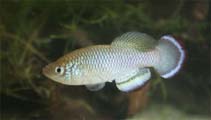
Espinhos dorsais (total) : 0; Raios dorsais moles (total) : 16 - 17; Espinhos anais: 0; Raios anais moles: 16 - 17; Vértebras: 27. Diagnosis: Males similar to other members of Nothobranchius taeniopygus species-group, differing from all other species of Nothobranchius by caudal and anal fins having broad pale sub-marginal band and dark margin (Ref. 86819). Nothobranchius oestergaardi differs from members of N. taeniopygus species-group by the following combination of characters: proximal portion of caudal fin plain red, vs. proximally irregularly spotted in N. boklundi, N. hassoni, N. kafuensis, N. polli, N. rosenstocki, N. symoensi and N. taenipygus or caudal fin covered with spots in N. brieni and N. malaissei; dorsal fin without coloured margin, vs. black fin margin in N. rubroreticulatus or broad light blue fin margin in N. brieni, N. polli and N. symoensi; body without distinct black spots anteriorly, vs. black spots present in N. rosenstocki and N. taeniopygus; anal fin striped, vs. anal fin irregularly striped in N. hassoni and N. polli, spots concentrated on proximal portion in N. brieni, N. kafuensis, and N. malaissei, or anal fin completely marbled in N. rosenstocki and N. symoensi; distal portion of anal fin cream then light blue, vs. yellow in N. boklundi, N. polli, pale yellow to yellow white in N. taeniopygus, light blue or orange in N. kafuensis, light blue in N. rubroreticulatus and red in N. rosenstocki; and with broad dark brown border, vs. narrow dark border in N. boklundi, N. brieni, N. kafuensis, N. polli, or light blue margin in N. symoensi; distal portion of pelvic fin plain light blue, vs. spotted in N. boklundi N. brieni, N. kafuensis and N. polli, plain red in N. rosenstocki, black in N. rubroreticulatus and N. taeniopygus (Ref. 86819). Nothobranchius oestergaardi males with relatively shorter caudal peduncle compared to N. boklundi, 17.0-21.3 vs. 19.1-26.6% of standard length; shallower and longer caudal peduncle compared to N. rosenstocki, 13.6-16.0 vs. 10.1-12.9% of standard length and 17.0-21.3 vs. 12.5-14.5% of standard length respectively; shallower caudal peduncle compared to N. symoens, 13.6-16.0 vs. 12.8% of standard length; longer predorsal length compared to N. hassoni, 57.5-62.5 vs. 52.8-56.4% of standard length, N. rosenstocki, 57.5-62.5 vs. 48.3-52.9% of standard length, N. rubroreticulatus, 57.5-62.5 vs. 53.3-57.6% of standard length, and N. symoensi, 57.5-62.5 vs. 55.1% of standard length; longer prepelvic length compared to N. brieni, 49.6-52.3 vs. 43.3-45.2% of standard length, N. taeniopygus, 49.6-52.3 vs. 42.1-48.9% of standard length, and N. symoensi, 49.6-52.3 vs. 48.2% of standard length; and longer preanal length compared to N. brieni, 56.2-64.4 vs. 52.9-54.5% of standard length (Ref. 86819).
Body shape (shape guide): fusiform / normal; Cross section: oval.
The type locality was at the time of collection a pond about 15 m in diameter and circa 1.5 m deep at its centre, extending on one side into the grass for about further 10 m and with a depth of 0.5 m (Ref. 86819). The aquatic vegetation consisted of a Nymphea species; the water was light clay grey and turbid, with pH 6.1 and conductivity 207 µS/cm (Ref. 86819).
Ciclo de vida e comportamento de acasalamento
Maturidade | Reprodução | Desova | Ovos | Fecundidade | Larvas
Valdesalici, S. and G. Amato, 2011. Nothobranchius oestergaardi (Cyprinodontiformes: Nothobranchiidae), a new annual killifish from Mweru Wantipa Lake drainage basin, northern Zambia. aqua, Int. J. Ichthyol. 17(2):111-119. (Ref. 86819)
Categoria na Lista Vermelha da IUCN (Ref. 130435: Version 2025-2 (Global))
Ameaça para o homem
Harmless
Utilização humana
Pescarias: sem interesse
Ferramentas
Relatórios especiais
Descarregue XML
Fontes da internet
Estimativas baseadas em modelos
Índice de diversidade filogenética (Ref.
82804): PD
50 = 0.5000 [Uniqueness, from 0.5 = low to 2.0 = high].
Bayesian length-weight: a=0.01096 (0.00461 - 0.02608), b=2.94 (2.74 - 3.14), in cm total length, based on LWR estimates for this (Sub)family-body shape (Ref.
93245).
Nível Trófico (Ref.
69278): 3.1 ±0.4 se; based on size and trophs of closest relatives
Vulnerabilidade da pesca (Ref.
59153): Low vulnerability (10 of 100).
🛈