Classification / Noms
Noms communs | Synonymes | Catalog of Fishes(Genre, Espèce) | ITIS | CoL | WoRMS | Cloffa
>
Synbranchiformes (Spiny eels) >
Mastacembelidae (Spiny eels)
Etymology: Mastacembelus: Greek, mastax, -agos = bite + Greek, emballo = to throw oneself (Ref. 45335); apectoralis: The species name, apectoralis, an adjective, alludes to the absence of pectoral fins, and is formed from the Latin 'a', meaning without, and 'pectoralis', a Latinized version of pectoral (Ref. 86808).
Environnement : milieu / zone climatique / profondeur / gamme de distribution
Écologie
; eau douce benthopélagique; profondeur 3 - 7 m (Ref. 86808). Tropical
Africa: Lake Tanganyika in Zambia (Ref. 86808).
Taille / Poids / Âge
Maturité: Lm ? range ? - ? cm
Max length : 16.3 cm SL mâle / non sexé; (Ref. 86808)
Description synthétique
Clés d'identification | Morphologie | Morphométrie
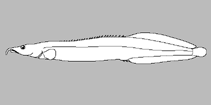
Épines dorsales (Total) : 32 - 34; Rayons mous dorsaux (Total) : 58 - 69; Épines anales: 3; Rayons mous anaux: 66 - 67; Vertèbres: 77 - 80. Diagnosis: Mastacembelus apectoralis differs from all other mastacembelid species by the absence of pectoral fins (Ref. 86808). It is endemic to Lake Tanganyika and is placed within the Lake Tanganyika species flock; it differs from other members of this radiation by a near absence of scales, present only on the margin of the caudal peduncle and between caudal-fin rays, a very short rostral appendage and well-developed adductor mandibulae muscles forming a distinctive head shape; the lack of pigmentation distinguishes this species from all other Tanganyikan species, with the exception of M. micropectus and M. cunningtoni, although the latter species has a distinctive dark spot on the caudal and pectoral fins; both M. apectoralis and its sister species, M. micropectus, lack teeth on the palatine; Mastacembelus apectoralis has 32-34 dorsal spines, and based on this count, is distinguished from five other species in the Lake Tanganyika flock, M. platysoma, M. zebratus, M. polli, M. cunningtoni and M. moorii, which have fewer spines, 21-29; however, all other Lake Tanganyika species have overlapping spine count ranges, 24-38, at least in part with that of M. apectoralis; vertebral counts of M. apectoralis, 77-80, are in the region of those of M. micropectus and M. albomaculatus, are greater than M. zebratus, but are lower than other Tanganyikan species (Ref. 86808).
Body shape (shape guide): eel-like; Cross section: circular.
Found in a complex rocky habitat, consisting of multiple layers of rock, at a depth of 3-7 m (Ref. 86808).
Cycle de vie et comportement reproducteur
Maturité | Reproduction | Frai | Œufs | Fécondité | Larves
Brown, K.J., R. Britz, R. Bills, L. Rüber and J.J. Day, 2011. Pectoral fin loss in the Mastacembelidae: a new species from Lake Tanganyika. J. Zool. 284(4):286-293. (Ref. 86808)
Statut dans la liste rouge de l'IUCN (Ref. 130435: Version 2025-2 (Global))
Menace pour l'homme
Harmless
Utilisations par l'homme
Outils
Articles particuliers
Télécharger en XML
Sources Internet
Estimations basées sur des modèles
Indice de diversité phylogénétique (Réf.
82804): PD
50 = 0.5000 [Uniqueness, from 0.5 = low to 2.0 = high].
Bayesian length-weight: a=0.00269 (0.00129 - 0.00562), b=2.94 (2.76 - 3.12), in cm total length, based on LWR estimates for this (Sub)family-body shape (Ref.
93245).
Niveau trophique (Réf.
69278): 3.6 ±0.6 se; based on size and trophs of closest relatives
Résilience (Réf.
120179): Haut, temps minimum de doublement de population inférieur à 15 mois (Preliminary K or Fecundity.).
Vulnérabilité de la pêche (Ref.
59153): Low vulnerability (10 of 100).
🛈