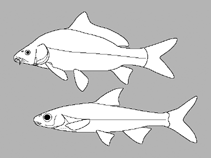
Classification / Noms
Noms communs | Synonymes | Catalog of Fishes(Genre, Espèce) | ITIS | CoL | WoRMS | Cloffa
>
Cypriniformes (Carps) >
Cyprinidae (Minnows or carps) > Labeoninae
Etymology: bamen: The specific epithet, used as a noun in apposition, is made from Ba Men, the local name of this and similar species (Ref. 86883).
Environnement : milieu / zone climatique / profondeur / gamme de distribution
Écologie
; eau douce benthopélagique. Tropical
Asia: China. Known only from a tributary flowing into the Zuo-Jiang of the Pearl River drainage at Jingxi County, Guangxi Province, South China (Ref. 86883).
Taille / Poids / Âge
Maturité: Lm ? range ? - ? cm
Max length : 10.6 cm SL mâle / non sexé; (Ref. 86883)
Description synthétique
Clés d'identification | Morphologie | Morphométrie
Vertèbres: 41 - 42. Body elongate, compressed laterally, with greatest depth at dorsal-fin origin and least depth of caudal peduncle slightly closer to caudal-fin base than to posterior end of anal-fin base. Dorsal profile of body gradually ascending from snout tip to dorsal-fin origin; from there to origin of dorsal procurrent caudal-fin rays profile slightly concave. Ventral profile from tip of snout to pectoral-fin insertion nearly straight; from there to anal-fin origin convex; anal-fin base straight; from posterior end of anal-fin base to origin of ventral procurrent caudal-fin rays slightly concave.
Head relatively small, longer than wide. Eye medium-sized with a wide, slightly convex interorbital space, dorsolaterally placed in anterior half of head. Snout blunt in lateral view and pointed in dorsal view, with a shallow groove running along anteroventral border of lachrymal from rostral-barbel base to lateral extremity of rostral cap; no tubercles on its tip and anterior portion of lachrymal. Two pairs of well-developed barbels; rostral barbel positioned at anterior end of shallow sublachrymal groove on each side of snout and extending to posterior margin of eye or not; maxillary barbel rooted in corner of mouth, originating from exterior surface of confluence between lateral lobe of lower lip and lateral extremity of rostral cap, and extending beyond posterior margin of eye to opercle. Mouth inferior and arched. (Ref. 86883).
Body shape (shape guide): fusiform / normal.
Cycle de vie et comportement reproducteur
Maturité | Reproduction | Frai | Œufs | Fécondité | Larves
Zhu, Y., E. Zhang, Zhang M. and Y.-Q. Han, 2011. Cophecheilus bamen, a new genus and species of labeonine fishes (Teleostei: Cyprinidae) from South China. Zootaxa 2881:39-50. (Ref. 86883)
Statut dans la liste rouge de l'IUCN (Ref. 130435: Version 2025-2 (Global))
Menace pour l'homme
Harmless
Utilisations par l'homme
Outils
Articles particuliers
Télécharger en XML
Sources Internet
Estimations basées sur des modèles
Indice de diversité phylogénétique (Réf.
82804): PD
50 = 0.7500 [Uniqueness, from 0.5 = low to 2.0 = high].
Bayesian length-weight: a=0.00933 (0.00435 - 0.02001), b=3.05 (2.88 - 3.22), in cm total length, based on LWR estimates for this (Sub)family-body shape (Ref.
93245).
Résilience (Réf.
120179): Haut, temps minimum de doublement de population inférieur à 15 mois (Preliminary K or Fecundity.).
Vulnérabilité de la pêche (Ref.
59153): Low vulnerability (10 of 100).
🛈