>
Gobiiformes (Gobies) >
Gobiidae (Gobies) > Gobiinae
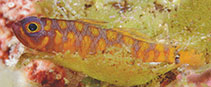
Etymology: Trimma: Greek, trimma, -atos = something crushed (Ref. 45335); maiandros: Named for Maiandros, the god of the winding Maeander River in Phrygia (currently known as the Büyük Menderes River in Turkey), son of Oceanus and his sister Tethys. The English word 'meander', a winding, crooked, or involved course, is in allusion to the zigzag pattern of
grey to blue lines on the body; a noun in apposition.
More on authors: Hoese, Winterbottom & Reader.
Môi trường: môi trường / vùng khí hậu / Mức độ sâu / phạm vi phân phối
Sinh thái học
biển cùng sống ở rạn san hô; mức độ sâu 1 - 55 m (Ref. 86820). Tropical
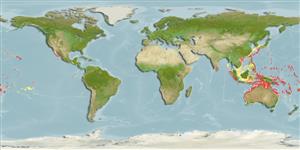
Indo-Pacific: Cocos (Keeling) Islands in the Indian Ocean and from Japan, Marshall and Mariana Islands to Samoa and Australia in the Pacific.
Bộ gần gũi / Khối lượng (Trọng lượng) / Tuổi
Chín muồi sinh dục: Lm ? range ? - ? cm
Max length : 2.7 cm SL con đực/không giới tính; (Ref. 86820)
Mô tả ngắn gọn
Khóa để định loại | Hình thái học | Sinh trắc học
Các tia vây lưng cứng (tổng cộng) : 6 - 8; Các vây lưng mềm (tổng cộng) : 8 - 10; Tia cứng vây hậu môn: 1; Tia mềm vây hậu môn: 7 - 9; Động vật có xương sống: 26. This species is characterized by the following: reduced predorsal scales, usually not crossing the midline (midline naked or partly naked); cycloid scales at sides of nape reaching to above a point between posterior margin of operculum and eyes; no scales on cheeks nor opercles; pectoral base usually fully scaled, posterodorsal 2 scales slightly enlarged; prepelvic covered with small cycloid scales in 5-6 rows; interorbital narrow, with moderate groove; groove absent or very shallow behind eyes (shallow between eyes and absent behind eyes in juveniles); a low distinct ridge at posterior end of interorbital; gill opening extending forward to below posterior margin of pupil; nape crest low from first dorsal origin to above posterior opercular margin, reaching to the shallow median groove; groove extending to just behind eyes; pectoral rays unbranched or with 1-5 rays branched at extreme tips; fifth pelvic ray unbranched, rest of rays with 2 terminal tips; D2 usually I,9; A usually I,8; pelvic fins largely separate, connected only at base; fins widely separate, distance between 2 fins greater than base of single pelvic fin; pelvic scale covering membrane, with fifth ray about one-fourth to one-half length of fourth ray; dark brown spot or bar extending posteroventrally from eye, body with irregular brown interconnecting bars, forming zigzag pattern (Ref. 86884).
Body shape (shape guide): fusiform / normal; Cross section: compressed.
Occurs in mid to outer barrier reefs, but much more common on outer barrier islands (Ref. 86820). Also found in caves and crevices (Ref. 90102).
Vòng đời và hành vi giao phối
Chín muồi sinh dục | Sự tái sinh sản | Đẻ trứng | Các trứng | Sự sinh sản | Ấu trùng
Hoese, D.F., R. Winterbottom and S. Reader, 2011. Trimma maiandros, a new species of pygmy goby (Gobiidae) from the Indo-west Pacific. aqua, Int. J. Ichthyol. 17(2):103-110. (Ref. 86820)
Tình trạng Sách đỏ IUCN (Ref. 130435: Version 2025-2 (Global))
Mối đe dọa đối với con người
Harmless
Sử dụng của con người
Các nghề cá: không ích lợi (thú vị)
Các công cụ
Báo cáo đặc biệt
Tải xuống XML
Các nguồn internet
Ước tính dựa trên mô hình
Nhiệt độ ưa thích (Tài liệu tham khảo
123201): 24.3 - 28.8, mean 27.5 °C (based on 344 cells).
Chỉ số đa dạng phát sinh loài (Tài liệu tham khảo
82804): PD
50 = 0.5000 [Uniqueness, from 0.5 = low to 2.0 = high].
Bayesian length-weight: a=0.01023 (0.00477 - 0.02194), b=3.01 (2.83 - 3.19), in cm total length, based on LWR estimates for this (Sub)family-body shape (Ref.
93245).
Sự dễ bị tổn thương của nghề đánh cá (Ref.
59153): Low vulnerability (10 of 100).
🛈
Chất dinh dưỡng (Ref.
124155): Calcium = 324 [142, 907] mg/100g; Iron = 1.54 [0.71, 3.20] mg/100g; Protein = 18.1 [16.0, 19.9] %; Omega3 = 0.182 [0.066, 0.460] g/100g; Selenium = 31.9 [11.5, 78.9] μg/100g; VitaminA = 129 [30, 535] μg/100g; Zinc = 3.81 [2.21, 6.09] mg/100g (wet weight);