>
Siluriformes (Catfishes) >
Amphiliidae (Loach catfishes) > Leptoglaninae
Etymology: Zaireichthys: Composed form Zaire river + Greek,ichtys = fish; the habitat of this fish (Ref. 45335); monomotapa: Named, as a noun in apposition, after the historical Kingdom of Monomotapa, 'Monomotapa' being the old Portuguese spelling; this encompassed the area currently occupied by Mozambique and Zimbabwe and thus almost all of the distribution of this species (Ref. 86935).
Entorno: milieu / zona climática / rango de profundidad / gama de distribución
Ecología
; agua dulce bentopelágico. Tropical
Africa: widespread in the tributaries of middle and lower Zambezi River, tributaries of Lake Malawi, Pungwe River, Buzi River and Save River (Ref. 86935, 94654).
Tamaño / Peso / Edad
Madurez: Lm ? range ? - ? cm
Max length : 3.8 cm SL macho / no sexado; (Ref. 86935); 4.1 cm SL (female)
Descripción breve
Claves de identificación | Morfología | Morfometría
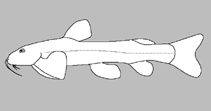
Espinas dorsales (total) : 2; Radios blandos dorsales (total) : 6 - 7; Espinas anales: 0; Radios blandos anales: 10 - 12; Vértebra: 35 - 38. Diagnosis: This species differs from Zaireichthys conspicuus, Z. lacustris and Z. maravensis in the narrow premaxillary tooth patch and the long lateral line, extending beyond base of anal fin; from Z. kunenensis in the narrower premaxillary tooth patch and the greater number of branched caudal rays, 14-16 vs. 11-14; from Z. kavangoensis in the longer lateral line, extending beyond anal fin and usually past adipose vs. above anterior to middle of anal fin; from Z. kafuensis and Z. pallidus in the longer lateral line and the greater number of caudal rays, 14-16 vs. 9-13, and pectoral-fin rays, 7-8 vs. 5-7 (Ref. 86935).
Body shape (shape guide): elongated.
Found in flowing water with a sandy substrate; they do not adapt to dams and do not occur in Lake Kariba (Ref. 94654). They partly bury themselves in the sand, leaving only the head exposed, and snap at particles of food, such as minute aquatic animals (Ref. 94654).
Ciclo vital y comportamiento de apareamiento
Madurez | Reproducción | Puesta | Huevos | Fecundidad | Larva
Eccles, D.H., D. Tweddle and P.H. Skelton, 2011. Eight new species in the dwarf catfish genus Zaireichthys (Siluriformes: Amphiliidae). Smithiana Bull. (13):3-28. (Ref. 86935)
Situación en la Lista Roja de la UICN (Ref. 130435: Version 2025-2 (Global))
Amenaza para el ser humano
Harmless
Usos humanos
Herramientas
Informes especiales
Descargar XML
Fuentes de Internet
Estimaciones basadas en modelos
Índice de diversidad filogenética (Referencia
82804): PD
50 = 0.5000 [Uniqueness, from 0.5 = low to 2.0 = high].
Bayesian length-weight: a=0.00389 (0.00180 - 0.00842), b=3.12 (2.94 - 3.30), in cm total length, based on all LWR estimates for this body shape (Ref.
93245).
Nivel trófico (Referencia
69278): 3.0 ±0.4 se; based on size and trophs of closest relatives
Vulnerabilidad pesquera (Ref.
59153): Low vulnerability (10 of 100).
🛈