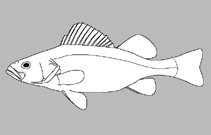
Classification / Noms
Noms communs | Synonymes | Catalog of Fishes(Genre, Espèce) | ITIS | CoL | WoRMS | Cloffa
>
Perciformes/Percoidei (Perchs) >
Percidae (Perches) > Etheostomatinae
Etymology: Etheostoma: Greek, etheo = to strain + Greek, stoma = mouth; Rafinesque said "various mouths", but Jordan and Evermann suggest the name might have been intended as "Heterostoma (Ref. 45335).
Environnement : milieu / zone climatique / profondeur / gamme de distribution
Écologie
; eau douce benthopélagique. Subtropical
North America: Santee and Savannah River drainages and Yadkin River system (downstream to and including the South Yadkin River and Bear Creek) of the Pee Dee River drainage in North Carolina, northern South Carolina and southern Virgina, USA.
Taille / Poids / Âge
Maturité: Lm ? range ? - ? cm
Max length : 6.3 cm SL mâle / non sexé; (Ref. 87049); 6.1 cm SL (female)
Description synthétique
Clés d'identification | Morphologie | Morphométrie
Épines dorsales (Total) : 5 - 8; Rayons mous dorsaux (Total) : 11 - 15; Rayons mous anaux: 7 - 10. This species belongs to the subgenus Catonotus and Etheostoma flabellare complex and is distinguished from Etheostoma flabellare by the combination of the following characters: seven or few, moderate to widely space, dark, distinct, transverse bars per side, usually 15 or less total; 2 or more wedge-shaped transverse bars in nuptial males and usually extending one to two scales below lateral line; nuptial male body color above and below lateral line yellow, golden yellow or golden tan, sharply contrasting with dark bars; scale pigmentation absent, concealed, or confined to areas above lateral line near dorsum or caudal peduncle region, not forming pattern on body; absence of horizontal dark line along body; lateral line usually 42-50, usually 77-95% pored, pored lateral-line scales usually 33-45; dorsal-fin spines modally 7; modally 40%-60% of belly covered by scales; dorsal saddles modally 7 (Ref. 87049).
Body shape (shape guide): elongated.
Cycle de vie et comportement reproducteur
Maturité | Reproduction | Frai | Œufs | Fécondité | Larves
Blanton, R.E. and G.A. Schuster, 2008. Taxonomic status of Etheostoma brevispinum, the Carolina fantail darter (Percidae: Catonotus). Copeia 2008(4):844-857. (Ref. 87049)
Statut dans la liste rouge de l'IUCN (Ref. 130435: Version 2025-2 (Global))
Menace pour l'homme
Harmless
Utilisations par l'homme
Outils
Articles particuliers
Télécharger en XML
Sources Internet
Estimations basées sur des modèles
Indice de diversité phylogénétique (Réf.
82804): PD
50 = 0.5000 [Uniqueness, from 0.5 = low to 2.0 = high].
Bayesian length-weight: a=0.00676 (0.00303 - 0.01510), b=3.12 (2.94 - 3.30), in cm total length, based on LWR estimates for this Genus-body shape (Ref.
93245).
Niveau trophique (Réf.
69278): 3.3 ±0.5 se; based on size and trophs of closest relatives
Résilience (Réf.
120179): Haut, temps minimum de doublement de population inférieur à 15 mois (Preliminary K or Fecundity.).
Vulnérabilité de la pêche (Ref.
59153): Low vulnerability (10 of 100).
🛈