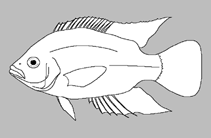
Klassificering / Namn
Populärnamn | synonymer | Catalog of Fishes(Släkte, Arter) | ITIS | CoL | WoRMS | Cloffa
>
Cichliformes (Cichlids, convict blennies) >
Cichlidae (Cichlids) > Pseudocrenilabrinae
Etymology: Petrotilapia: Latin,petra = stone + Bechuana, African native thiape = fish (Ref. 45335); mumboensis: The name mumboensis is in reference to Mumbo Island, Malawi, where this species is very common and from where the holotype was collected; an adjective (Ref. 87181).
Miljö: miljö / Klimatzon / djupintervall / distributionsområde
Ekologi
; sötvatten pelagiska. Tropical; 13°S - 14°S, 34°E - 35°E
Africa: Lake Malawi in Malawi (Ref. 87181).
Storlek / Vikt / Ålder
Könsmognad: Lm ? range ? - ? cm
Max length : 12.7 cm SL hane/ej könsbestämd; (Ref. 87181)
Kort beskrivning
Bestämningsnycklar | Morfologi | Morfometri
Taggstrålar i ryggfenan (totalt) : 16 - 18; Mjukstrålar i ryggfenan (totalt) : 8 - 10; Taggstrålar i analfenan: 3; Mjukstrålar i analfenan: 7 - 9. Diagnosis: The dark submarginal band in the spinous part of the dorsal fin of both male and female distinguishes Petrotilapia mumboensis from P. tridentiger, P. xanthos, P. flaviventris, and P. palingnathos, which lack such a band (Ref. 87181). Males of P. mumboensis are light blue with 8-10 dark blue vertical bars, light blue cheek, and a light blue to gray gular region, which distinguishes it from P. genalutea, P. nigra, P. chrysos, P. microgalana, and P. pyroscelos; Petrotilapia genalutea are dull gray-blue with 5-7 black vertical bars with orange-yellow cheek and a black throat; males of P. nigra and P. chrysos are predominantly blue-black with 7-10 gray/brown bars, have a dark blue cheek, and a black throat; males of P. microgalana are bright blue with 5-7 faint black vertical bars, and have a light blue cheek and a yellow throat while those of P. pyroscelos are blue with bronze highlights and have a red pelvic fin (Ref. 87181). Females of P. mumboensis are gray-brown to light brown with a conspicuous black submarginal band in the dorsal fin and are distinguished from those of P. genalutea, P. nigra, P. chrysos, and P. microgalana by the lack of horizontal elements in the pigmentation pattern on the flank and from females of P. pyroscelos, which are brown with faint blue and yellow highlights and often have dorso-lateral series of faint spots (Ref. 87181).
Body shape (shape guide): fusiform / normal.
Livscykel och parningsbeteende
Könsmognad | Reproduktion | Lek | Ägg | Fekunditet | Larver
Lundeba, M., J.R. Stauffer Jr. and A. F. Konings, 2011. Five new species of the genus Petrotilapia (Teleostei: Cichlidae), from Lake Malawi, Africa. Ichthyol. Explor. Freshwat. 22(2):149-168. (Ref. 87181)
Status på IUCN:s rödlista (Ref. 130435: Version 2025-2 (Global))
Hot mot människor
Harmless
Mänskliga användningsområden
Verktyg
Särskilda rapporter
Ladda ner XML
Internet-källor
Uppskattningar baserade på modeller
Index för fylogenetisk mångfald (Ref.
82804): PD
50 = 0.5010 [Uniqueness, from 0.5 = low to 2.0 = high].
Bayesian length-weight: a=0.01445 (0.00671 - 0.03113), b=2.99 (2.82 - 3.16), in cm total length, based on LWR estimates for this (Sub)family-body shape (Ref.
93245).
Trofisk nivå (Ref.
69278): 3.4 ±0.4 se; based on size and trophs of closest relatives
Resiliens (Ref.
120179): Hög, lägsta populationsfördubblingstid mindre än 15 månader (Preliminary K or Fecundity.).
Sårbarhet i fisket (Ref.
59153): Low vulnerability (10 of 100).
🛈