>
Eupercaria/misc (Various families in series Eupercaria) >
Labridae (Wrasses) > Hypsigenyinae
Etymology: Choerodon: Greek, choiros = a pig + odous = teeth (Ref. 45335); referrring to the prominent anterior canines of the species in this genus (Ref. 116605).
More on author: Ogilby.
Environnement : milieu / zone climatique / profondeur / gamme de distribution
Écologie
marin démersal; profondeur 10 - 40 m (Ref. 90102). Tropical
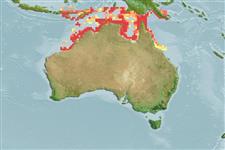
Western Central Pacific: northwestern Australia (Ref. 3131) and Papua New Guinea (Ref. 6192).
Taille / Poids / Âge
Maturité: Lm ? range ? - ? cm
Max length : 25.0 cm TL mâle / non sexé; (Ref. 3132)
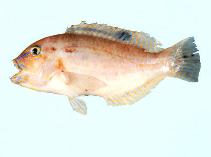
Épines dorsales (Total) : 13; Rayons mous dorsaux (Total) : 7; Épines anales: 3; Rayons mous anaux: 10. Body mostly pale with faint broad dusky bands especially dorsally. A prominent ocellated dark spot present on dorsal fin between last few spines. Body deep at level of dorsal-fin origin (2.3 to 2.6 times in SL). Second prominent anterior canine mostly straight, only slightly curved in large specimens, angled dorsolaterally and sometimes slightly posteriorly.
Body shape (shape guide): fusiform / normal.
Adults inhabit flat sandy or weedy areas (Ref. 3131). Found solitary in rubble, silt or sand bottoms (Ref. 90102). Oviparous, distinct pairing during breeding (Ref. 205). A good food fish.
Cycle de vie et comportement reproducteur
Maturité | Reproduction | Frai | Œufs | Fécondité | Larves
Oviparous, distinct pairing during breeding (Ref. 205).
Sainsbury, K.J., P.J. Kailola and G.G. Leyland, 1985. Continental shelf fishes of the northern and north-western Australia. An illustrated guide. CSIRO Division of Fisheries Research; Clouston & Hall and Peter Pownall Fisheries Information Service, Canberra, Australia. 375 p. (Ref. 3131)
Statut dans la liste rouge de l'IUCN (Ref. 130435: Version 2025-2 (Global))
Menace pour l'homme
Harmless
Utilisations par l'homme
Outils
Articles particuliers
Télécharger en XML
Sources Internet
Estimations basées sur des modèles
Température préférée (Réf.
123201): 24.7 - 28.8, mean 27.7 °C (based on 228 cells).
Indice de diversité phylogénétique (Réf.
82804): PD
50 = 0.5000 [Uniqueness, from 0.5 = low to 2.0 = high].
Bayesian length-weight: a=0.00955 (0.00426 - 0.02142), b=3.10 (2.91 - 3.29), in cm total length, based on LWR estimates for this (Sub)family-body shape (Ref.
93245).
Niveau trophique (Réf.
69278): 3.4 ±0.4 se; based on size and trophs of closest relatives
Résilience (Réf.
120179): Milieu, temps minimum de doublement de population : 1,4 à 4,4 années (Preliminary K or Fecundity.).
Vulnérabilité de la pêche (Ref.
59153): Low vulnerability (15 of 100).
🛈
Nutriments (Ref.
124155): Calcium = 174 [90, 339] mg/100g; Iron = 1.15 [0.62, 2.29] mg/100g; Protein = 18.1 [15.3, 20.2] %; Omega3 = 0.264 [0.153, 0.463] g/100g; Selenium = 39.3 [20.4, 81.1] μg/100g; VitaminA = 37.5 [10.4, 146.9] μg/100g; Zinc = 1.24 [0.86, 2.04] mg/100g (wet weight);