>
Osteoglossiformes (Bony tongues) >
Mormyridae (Elephantfishes)
Etymology: Petrocephalus: Latin, petra = stone + Greek, kephale = head (Ref. 45335); zakoni: This species is named in honor of Harold H. Zakon; in addition to his many contributions to neuroethology, which inspires a new area of research on genes that underlie electrolocation and electrical communication in gymnotiform and mormyroid fishes (Ref. 85331).
Eponymy: Dr Harold H Zakon is a Professor (since 1999) at the Department of Neuroscience, College of Natural Sciences at the University of Texas, as well as Chairman of Neurobiology. [...] (Ref. 128868), visit book page.
Environnement : milieu / zone climatique / profondeur / gamme de distribution
Écologie
; eau douce benthopélagique. Tropical
Africa: Congo River basin (Ref. 85331, 113655) in Central African Republic, Republic of Congo and Democratic Republic of the Congo.
Taille / Poids / Âge
Maturité: Lm ? range ? - ? cm
Max length : 8.6 cm SL mâle / non sexé; (Ref. 85331)
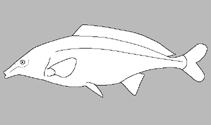
Diagnosis: Petrocephalus zakoni is distinguished from all other Petrocephalus species in Central Africa by the following combination of characteristics: dorsal fin with 23 or 24 branched rays; anal fin with 27 or 28 branched rays; eye large, the ratio head length and eye-diameter between 3,1 and 3,3; mouth small, the ratio head length and mouth width between 4.4 and 5.0; 10 teeth of fewer in the upper jaw; and 22 teeth or fewer in the lower jaw (Ref. 85331). It has a unique pigmentation pattern consisting of three well defined black patches: (1) an intense dark mark on each side of the body close to the anterior base of the dorsal fin, often extending onto the first dorsal rays, forming a characteristic saddle across the dorsum; (2) a mark on each side of the body at the base of the pectoral fin; (3) a crescent-shaped mark on each side of the body centered at the base of the caudal fin, extending onto the upper and lower parts of the caudal fin (Ref. 85331).
Body shape (shape guide): fusiform / normal.
Cycle de vie et comportement reproducteur
Maturité | Reproduction | Frai | Œufs | Fécondité | Larves
Lavoué, S., J.P. Sullivan and M.E. Arnegard, 2010. African weakly electric fishes of the genus Petrocephalus (Osteoglossomorpha: Mormyridae) of Odzala National Park, Republic of the Congo (Lékoli River, Congo River basin) with description of five new species. Zootaxa 2600:1-52. (Ref. 85331)
Statut dans la liste rouge de l'IUCN (Ref. 130435: Version 2025-2 (Global))
Menace pour l'homme
Harmless
Utilisations par l'homme
Outils
Articles particuliers
Télécharger en XML
Sources Internet
Estimations basées sur des modèles
Indice de diversité phylogénétique (Réf.
82804): PD
50 = 0.5000 [Uniqueness, from 0.5 = low to 2.0 = high].
Bayesian length-weight: a=0.01549 (0.00672 - 0.03569), b=2.87 (2.69 - 3.05), in cm total length, based on LWR estimates for this Genus-body shape (Ref.
93245).
Niveau trophique (Réf.
69278): 3.2 ±0.4 se; based on size and trophs of closest relatives
Vulnérabilité de la pêche (Ref.
59153): Low vulnerability (10 of 100).
🛈