>
Osteoglossiformes (Bony tongues) >
Mormyridae (Elephantfishes)
Etymology: Petrocephalus: Latin, petra = stone + Greek, kephale = head (Ref. 45335); pulsivertens: The species name comes from the Latin 'pulsus', meaning impulse, beating; and from 'vertere', meaning to turn, exchange; the name describes the unusual EOD waveform of the species (Ref. 85331).
Môi trường: môi trường / vùng khí hậu / Mức độ sâu / phạm vi phân phối
Sinh thái học
; nước ngọt sống nổi và đáy. Tropical
Africa: middle Congo River basin (Ref. 85331, 113655) in Cameroon, Central African Republic and Republic of Congo.
Bộ gần gũi / Khối lượng (Trọng lượng) / Tuổi
Chín muồi sinh dục: Lm ? range ? - ? cm
Max length : 11.5 cm SL con đực/không giới tính; (Ref. 85331)
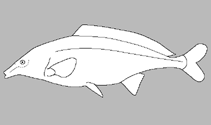
Diagnosis: Petrocephalus pulsivertens is distinguished from all other Petrocephalus species in Central Africa by the following combination of characteristics: dorsal fin with at least 25 branched rays; anal fin with at least 31 branched rays; mouth large, the ratio head length and mouth width between 2.0 and 3.7; 15-21 teeth in the upper jaw; 24-30 teeth in the lower jaw; and eye large, the ratio head length and eye-diameter between 3,2 and 3,5 (Ref. 85331). Pigmentation pattern consists of two distinctive melanin markings (black patches): (1) a distinct ovoid mark below the anterior base of the dorsal fin; and (2) a crescent-like mark, sometimes diffuse, centered at the base of the caudal fin and extending onto the upper and lower parts of the caudal fin (Ref. 85331).
Body shape (shape guide): fusiform / normal.
The EOD waveform of Petrocephalus pulsivertens resembles an inverted-polarity version of the 'typical' Petrocephalus EOD (Ref. 85331).
Vòng đời và hành vi giao phối
Chín muồi sinh dục | Sự tái sinh sản | Đẻ trứng | Các trứng | Sự sinh sản | Ấu trùng
Lavoué, S., J.P. Sullivan and M.E. Arnegard, 2010. African weakly electric fishes of the genus Petrocephalus (Osteoglossomorpha: Mormyridae) of Odzala National Park, Republic of the Congo (Lékoli River, Congo River basin) with description of five new species. Zootaxa 2600:1-52. (Ref. 85331)
Tình trạng Sách đỏ IUCN (Ref. 130435: Version 2025-2 (Global))
Mối đe dọa đối với con người
Harmless
Sử dụng của con người
Các công cụ
Báo cáo đặc biệt
Tải xuống XML
Các nguồn internet
Ước tính dựa trên mô hình
Chỉ số đa dạng phát sinh loài (Tài liệu tham khảo
82804): PD
50 = 0.5000 [Uniqueness, from 0.5 = low to 2.0 = high].
Bayesian length-weight: a=0.01549 (0.00672 - 0.03569), b=2.87 (2.69 - 3.05), in cm total length, based on LWR estimates for this Genus-body shape (Ref.
93245).
Mức dinh dưỡng (Tài liệu tham khảo
69278): 3.2 ±0.4 se; based on size and trophs of closest relatives
Thích nghi nhanh (Tài liệu tham khảo
120179): Chiêù cao, thời gian nhân đôi của chủng quần tối thiểu là dưới 15 tháng (Preliminary K or Fecundity.).
Sự dễ bị tổn thương của nghề đánh cá (Ref.
59153): Low vulnerability (10 of 100).
🛈