>
Siluriformes (Catfishes) >
Loricariidae (Armored catfishes) > Hypostominae
Etymology: Pseudolithoxus: Greek, pseudes = false + Greek, lithos = stone + Greek, oxys = sharp; stearleyi: Named after Ralph Stearley, Professor of Geology at Calvin College since 1992, whose patient introductory tutelage in fish osteology set the first author on his career (Ref. 87303).
Eponymy: Dr Ralph F Stearley is (since 1992) on the faculty of Calvin College, Grand Rapids, Michigan, where he is now Professor of Geology and Palaeontology. [...] (Ref. 128868), visit book page.
Môi trường: môi trường / vùng khí hậu / Mức độ sâu / phạm vi phân phối
Sinh thái học
; nước ngọt gần đáy. Tropical; 4°N - 3°N, 65°W - 66°W
South America: Venezuela, Amazonas State, Soromoni Creek (Ref. 87303)
Bộ gần gũi / Khối lượng (Trọng lượng) / Tuổi
Chín muồi sinh dục: Lm ? range ? - ? cm
Max length : 3.0 cm SL con đực/không giới tính; (Ref. 87303)
Mô tả ngắn gọn
Khóa để định loại | Hình thái học | Sinh trắc học
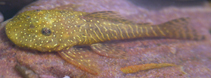
Soromonichthys may be diagnosed from all other Hypostominae by having a unique pattern of plate loss on the snout: Soromonichthys has naked skin covering its anteriormost snout margin, extending posteromedially over the mesethmoid to level approximately coequal with anterior bony rim of nostrils, and posterolaterally to about midlength of snout; plated region restricted to column along either side of mesethmoid that becomes broadly expanded posterolaterally to snout margin. Only three other Hypostominae genera have a loss of snout plates: Ancistrus, Chaetostoma, and Paulasquama. Ancistrus differs from Soromonichthys in having the naked region extending more posteriorly along the lateral margins of the snout and more evenly expanded posteriorly to near midlength of the snout (females) or beyond (males); all Ancistrus have plates along the posterolateralmost margins of the snout as well as medial plates over the posterior mesethmoid. Chaetostoma is similar to Ancistrus but with less developed or absent sexual dimorphism. Paulasquama differs in having naked region confined to bilaterally symmetrical patches on either side of the mesethmoid, each extending posteriorly to the anterior rim of the nostril; plates covering anterior and lateral margins of the snout and extending posteromedially over the mesethmoid continuous with posterior head plates. Soromonichthys is further distinguished from Ancistrus, Chaetostoma, and Paulasquama by having body coloration consisting of thin irregular light yellow to gold bars on a base color of irregularly mixed moderate to dark green (vs. coloration lacking thin light colored bars); from Ancistrus by lacking tentacles emergent from unplated regions of the snout, by having nasal no wider than canal (vs. nasal wide and almost square); and from Chaetostoma by having seven dorsal-fin rays (vs. eight to ten) (Ref. 87303).
Body shape (shape guide): elongated; Cross section: flattened.
All specimens were collected from shallow riffles and runs over clean cobble substrate interspersed with sand and patches of a rooted, moss-like aquatic macrophytes. Other loricariids collected in Soromoni Creek with this species were Ancistrus sp., Dekeyseria niveata, Exastilithoxus sp., and Rineloricaria formosa (Ref. 87303).
Vòng đời và hành vi giao phối
Chín muồi sinh dục | Sự tái sinh sản | Đẻ trứng | Các trứng | Sự sinh sản | Ấu trùng
Lujan, N.K. and J.W. Armbruster, 2011. Two new genera and species of Ancistrini (Siluriformes: Loricariidae) from the Western Guiana Shield. Copeia 2011(2):216-225. (Ref. 87303)
Tình trạng Sách đỏ IUCN (Ref. 130435: Version 2025-2 (Global))
Mối đe dọa đối với con người
Harmless
Sử dụng của con người
Các công cụ
Báo cáo đặc biệt
Tải xuống XML
Các nguồn internet
Ước tính dựa trên mô hình
Chỉ số đa dạng phát sinh loài (Tài liệu tham khảo
82804): PD
50 = 0.5078 [Uniqueness, from 0.5 = low to 2.0 = high].
Bayesian length-weight: a=0.01549 (0.00726 - 0.03306), b=2.96 (2.79 - 3.13), in cm total length, based on LWR estimates for this (Sub)family-body shape (Ref.
93245).
Sự dễ bị tổn thương của nghề đánh cá (Ref.
59153): Low vulnerability (10 of 100).
🛈