Klassifizierung / Names
Namen | Synonyme | Catalog of Fishes(Gattung, Arten) | ITIS | CoL | WoRMS | Cloffa
>
Perciformes/Cottoidei (Sculpins) >
Liparidae (Snailfishes)
Etymology: Paraliparis: Greek, para = the side of + Greek, liparis = fat (Ref. 45335); caninus: Name from Latin caninus for dog’s; the snout of the fish resembles the dog snout because of the massive lower jaw (Ref. 87306).
More on authors: Chernova & Prut'ko.
Umwelt: Milieu / Klimazone / Tiefenbereich / Verbreitungsgebiet
Ökologie
seewasser bathydemersal; tiefenbereich 1182 - 1651 m (Ref. 87306). Polar; 71°S - 73°S, 176°E - 179°E
Antarctic Pacific: Ross Sea.
Größe / Gewicht / Alter
Geschlechtsreife: Lm ? range ? - ? cm
Max length : 31.0 cm TL (female)
Kurzbeschreibung
Bestimmungsschlüssel | Morphologie | Morphometrie
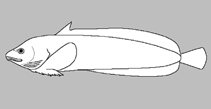
Diagnosis. Head is compressed from the sides. Lower jaw is massive, so that the mouth slit is almost at the head midline. Rad. pect. 4 (3 + 1), C 6, vert. 69 70, vert. abd. 11 12, P 17 19. Teeth are uniserial, except the region of symphysis. Snout is large, 40% of c.; interorbital distance is 41 42% of c. Gill opening is 19% of c, not exceeding eye diameter. Preanal distance is 38% of SL. Lower lobe of pectoral fin is short 10% of SL (Ref. 87306).
X ray. Vert. 69 (12 + 57), D 65, A 54. The first pterygiophore occupies a position between neural spines of vertebrae four and five. Hypural plate 1 one. C 6, and secondary rays absent. In paratype vert. 70 (11 + 59); rays of fins cannot be counted. Terminal preural vertebra is free of dorsal and anal fin rays: pterygiophore of the last D ray is between the processes of preural vertebrae 2 and 3, pterygiophore of the last A ray is between the processes of preural vertebrae 3 and 4. In pectoral fin, the notch is deep; fin lobes are separated almost to the insertion. Length of rays of the lower lobe is 94% of length of rays of its upper lobe. Upper ray of pectoral fin is slightly lower than eye level. Insertion of the lower ray of P is below preoperculum (Ref. 87306).
Pectoral girdle. In both specimens rad. pect. 4 (3 + 1), round; interradial fenestrae absent. The fourth (lower) radiale is noticeably bigger than the third one. Scapula has a short wide helve; coracoideum has a long thin helve without of ribs. P 17 (12 + 2 + 3), in paratype 19 (13 + 3 + 3). Of two rays of pectoral notch, upper ray is reduced to insertion; lower ray supporting fin membrane is very short; its length is 10 times less than the length of upper lobe. In paratype, two rays of the notch are not rudimentary, their length is 5 times less than the length of upper lobe. Anus opens immediately behind the vertical of the gill opening. Pyloric caeca 7. In female SL 296 mm, ovarian eggs immature, egg diameter does not exceed 2.2 mm. In female SL 284, 340 mature eggs with a diameter of 4.0–4.4 mm were counted; oocytes of the reserve fund did not exceed 2.7–3.0 mm. The area of anal opening is surrounded by scalopped skin folds. There is a small urinal papilla (Ref. 87306).
Coloration. Skin remnants on the body have a light pinkish color, the end of the caudal part is grayish; rear oral region is bluish lilac. Oral and gill cavities are gray. Peritoneum is black. Pyloric caeca and stomach are light (Ref. 87306).
Body shape (shape guide): elongated; Cross section: compressed.
The two specimens of P. caninus were found in stomachs of toothfish caught at the continental slope of the northern part of the Ross Sea at depths of 1,182-1,651m (Ref. 87306).
Lebenszyklus und Paarungsverhalten
Geschlechtsreife | Fortpflanzung | Ablaichen | Eier | Fruchtbarkeit | Larven
Chernova, N.V. and V.G. Prut’ko, 2011. Two new species of Paraliparis(Scorpaeniformes: Liparidae) from the Ross Sea (Antarctica). J. Ichthyol. 51(5):363-372. (Ref. 87306)
IUCN Rote Liste Status (Ref. 130435: Version 2025-2 (Global))
Bedrohung für Menschen
Harmless
Nutzung durch Menschen
Fischereien: nicht kommerziell
Tools
Zusatzinformationen
Download XML
Internet Quellen
Schätzungen auf der Grundlage von Modellen
Phylogenetischer Diversitätsindex (Ref.
82804): PD
50 = 0.5000 [Uniqueness, from 0.5 = low to 2.0 = high].
Bayesian length-weight: a=0.00525 (0.00237 - 0.01161), b=3.15 (2.96 - 3.34), in cm total length, based on LWR estimates for this (Sub)family-body shape (Ref.
93245).
Trophische Ebene (Ref.
69278): 3.6 ±0.5 se; based on size and trophs of closest relatives
Widerstandsfähigkeit (Ref.
120179): mittel, Verdopplung der Population dauert 1,4 - 4,4 Jahre. (Preliminary K or Fecundity.).
Anfälligkeit der Fischerei (Ref.
59153): Low vulnerability (21 of 100).
🛈