Classificação / Nomes
Nomes comuns | Sinônimos | Catalog of Fishes(Gênero, Espécies) | ITIS | CoL | WoRMS | Cloffa
>
Perciformes/Cottoidei (Sculpins) >
Liparidae (Snailfishes)
Etymology: Paraliparis: Greek, para = the side of + Greek, liparis = fat (Ref. 45335); vipera: Name derived from Latin vipera for snake, for the head of this species is flattened, as in the snake (Ref. 87306).
More on authors: Chernova & Prut'ko.
Meio ambiente: milieu / Zona climática / intervalo de profundidade / faixa de distribuição
Ecologia
marinhas batidemersal, usually 1727 - ? m (Ref. 87306). Polar; 75°S - 76°S, 170°W - 171°W
Antarctic Pacific: Ross Sea.
Tamanho / Peso / Idade
Maturidade: Lm ? range ? - ? cm
Max length : 3.7 cm TL (female)
Descrição suscinta
Chaves de identificação | Morfologia | Morfometria
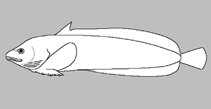
Diagnosis: head is flattened, and its width (84% of c) noticeably exceeds its depth (58%). Rad. pect. 3 (2 + 0 +1), vert. 70, vert. abd. 11; P 19, C 7. Teeth are uniserial, except the region of symphysis. Snout is 42% of c., and interorbital space is 33% of c. Gill opening is 18% of c and not longer than eye diameter. Preanal distance is 39% of SL. Lower lobe of pectoral fin is short, 10% of SL (Ref. 87306).
Description. Head is small, 6.3 times in SL and is noticeably flattened: head width (84% of c) considerably exceeds its depth (58%). Teeth on jaws are simple, small, cone shaped, and mainly uniserial. On the upper jaw, distally there is a row of 26 teeth, 5 short rows are added anteriorly. On the lower jaw, distally in a row there are approximately 70 teeth of even size; anteriorly there are 3–4 short rows. Lower jaw is of common appearance and not massive. Oral cleft reaches vertical of anterior margin of orbit. Respiratory membranes are wide: palatine and lower jaw membranes are 3 and 2 times wider than dental plates by a factor of three and two, respectively. Oral cavity lining is almost smooth; papillae on its surface are few. Orobuccal fold bears one fingerlike projection located on 1/6 of its length. Gill rakers 12; they are strongly conical and sharpened; spinules at their apices are hardly noticeable. Chin pores, judging from the location of their tubules, are closely set. Body is elongated and compressed from the sides. Preanal distance is 39% of SL (Ref. 87306).
X ray. Vert. 70 (11 + 59), D 61, A 56, C 7. It was impossible to determine the position of the first dorsal ray pterygiophore on the specimen. The first ray of A is under the seventh abdominal vertebra. Pterygiophore of the last dorsal fin ray is between processes of preural vertebrae 1 and 2; pterygiophore of the last dorsal fin ray is between processes of preural vertebrae 3 and 4 (Ref. 87306).
Pectoral girdle. Pectoral radials 3 (2 + 0 + 1); they are round and big; interradial fenestrae are absent. Scapula has a short, wide helve; coracoideum has a long helve, without lateral ribs. P 20 (15 + 2 + 3); rays of notch are not rudimentary. The length of notch rays is 30% of the upper lope length and length of lower lobe rays is 97%. Upper ray of pectoral fin is at the level of the lower third of the orbit; its lower ray is at the vertical of its anterior third. Anus opens under the gill opening. Pyloric caeca 6 (Ref. 87306).
Coloration. Skin on the head and body is lacking; its fragments on the abdomen are pinkish. Lips are blackish. Gill and oral cavities are smoky gray. Stomach is entirely light. Peritoneum is black (Ref. 87306).
Body shape (shape guide): elongated; Cross section: compressed.
A single specimen of P. vipera was found in the stomach of toothfish caught at the continental slope of the southeastern part of the Ross Sea at a depth of 1,727m (Ref. 87306).
Ciclo de vida ou comportamento de acasalamento
Maturidade | Reprodução | Desova | Ovos | Fecundidade | Larvas
Chernova, N.V. and V.G. Prut’ko, 2011. Two new species of Paraliparis(Scorpaeniformes: Liparidae) from the Ross Sea (Antarctica). J. Ichthyol. 51(5):363-372. (Ref. 87306)
Status na Lista Vermelha da UICN (Ref. 130435: Version 2025-2 (Global))
Ameaça para os humanos
Harmless
Uso pelos humanos
Pescarias: sem interesse
Ferramentas
Relatórios especiais
Baixar XML
Fontes da internet
Estimativas baseadas em modelos
Índice de diversidade filogenética (Ref.
82804): PD
50 = 0.5000 [Uniqueness, from 0.5 = low to 2.0 = high].
Bayesian length-weight: a=0.00525 (0.00237 - 0.01161), b=3.15 (2.96 - 3.34), in cm total length, based on LWR estimates for this (Sub)family-body shape (Ref.
93245).
Nível Trófico (Ref.
69278): 3.1 ±0.4 se; based on size and trophs of closest relatives
Resiliência (Ref.
120179): Elevada, tempo mínimo de duplicação da população menor que 15 meses (Preliminary K or Fecundity.).
Vulnerabilidade da pesca (Ref.
59153): Low vulnerability (10 of 100).
🛈