>
Osteoglossiformes (Bony tongues) >
Mormyridae (Elephantfishes)
Etymology: Petrocephalus: Latin, petra = stone + Greek, kephale = head (Ref. 45335); similis: The specific epithet similis is given in reference to the resemblance between this new species and P. sullivani (Ref. 87308).
Ambiente: milieu / zona climática / intervalo de profundidade / gama de distribuição
Ecologia
; Água doce bentopelágico. Tropical; 7°N - 6°N, 12°E - 13°E
Africa: Djerem River, upper Sanaga basin in Cameroon (Ref. 87308).
Tamanho / Peso / Idade
Maturidade: Lm ? range ? - ? cm
Max length : 11.9 cm SL macho/indeterminado; (Ref. 87308)
Descrição breve
Chaves de identificação | Morfologia | Morfometria
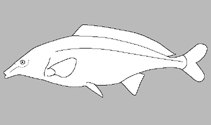
Diagnosis: Petrocephalus similis is distinguished from all other Petrocephalus species of Central Africa by the following combination of characteristics: body coloration gold/silver-white without melanin mark; 22–24 branched rays in the dorsal fin and 28-29 branched rays in the anal fin (Ref. 87308). Petrocephalus similis can be further distinguished from P. simus by its mouth opening under the posterior half of the eye vs. the anterior half of the eye in P. simus); its relatively deep caudal peduncle, the ratio caudal peduncle length and caudal peduncle depth between 2.2 and 2.6 vs. 2.8 in P. simus; and its greater number of scale rows between the anterior base of the anal fin and the lateral line, 16 or 17 vs. 12 in P. simus (Ref. 87308). Petrocephalus similis can be further distinguished from P. sullivani, by its proportionally larger mouth, the ratio head length and mouth width between 3.9 and 4.5 vs. 4.8 in P. sullivani; wider head, the ratio head length and head width between 1.6 and 1.9 vs. 2.0 in P. sullivani; and its shorter caudal peduncle, the ratio standard length and caudal peduncle length between 6.3 and 7.5 vs. 6.3 in P. sullivani (Ref. 87308). From the six Nilo-Sudanian species occurring in the Niger and Chad basins bordering the upper Sanaga, P. similis is easily distinguished from Petrocephalus pallidomaculatus, Petrocephalus soudanensis and Petrocephalus ansorgii by its complete absence of large melanin sub-dorsal spot; from Petrocephalus bane and Petrocephalus sauvagii, by its smaller mouth and fewer branched rays in the dorsal and anal fins; and from Petrocephalus bovei, by its fewer branched rays in the dorsal and anal fins and its larger maximum standard length (Ref. 87308).
Body shape (shape guide): fusiform / normal.
Ciclo de vida e comportamento de acasalamento
Maturidade | Reprodução | Desova | Ovos | Fecundidade | Larvas
Lavoué, S., 2011. A new species of Petrocephalus Marcusen 1854 (Osteoglossomorpha: Mormyridae) from the Sanaga River basin, Cameroon. Zootaxa 2934:20-28. (Ref. 87308)
Categoria na Lista Vermelha da IUCN (Ref. 130435: Version 2025-2 (Global))
Ameaça para o homem
Harmless
Utilização humana
Ferramentas
Relatórios especiais
Descarregue XML
Fontes da internet
Estimativas baseadas em modelos
Índice de diversidade filogenética (Ref.
82804): PD
50 = 0.5000 [Uniqueness, from 0.5 = low to 2.0 = high].
Bayesian length-weight: a=0.01549 (0.00672 - 0.03569), b=2.87 (2.69 - 3.05), in cm total length, based on LWR estimates for this Genus-body shape (Ref.
93245).
Nível Trófico (Ref.
69278): 3.3 ±0.4 se; based on size and trophs of closest relatives
Resiliência (Ref.
120179): Elevada, tempo mínimo de duplicação da população menor que 15 meses (Preliminary K or Fecundity.).
Vulnerabilidade da pesca (Ref.
59153): Low vulnerability (10 of 100).
🛈