Klassificering / Namn
Populärnamn | synonymer | Catalog of Fishes(Släkte, Arter) | ITIS | CoL | WoRMS | Cloffa
>
Siluriformes (Catfishes) >
Sisoridae (Sisorid catfishes) > Glyptosterninae
Etymology: Creteuchiloglanis: Name formed from the Latin prefix cret-, meaning to separate/distinguish, in combination with the generic name Euchiloglanis, alluding to features shared with, as well as distinguishing from, Euchiloglanis and Pareuchiloglanis; brachypterus: Name from Greek brachy, meaning shortened, and pterus, for fin, referring to the short pectoral, pelvic, and caudal fins, distinguishing the species from all congeners; noun in apposition (Ref. 87311).
Miljö: miljö / Klimatzon / djupintervall / distributionsområde
Ekologi
; sötvatten bentopelagisk. Tropical; 26°N - 25°N, 98°E - 99°E
Asia: China. Daying-Jiang and Longchuan-Jiang (branches of Irrawaddy River drainage), Yunnan Province.
Storlek / Vikt / Ålder
Könsmognad: Lm ? range ? - ? cm
Max length : 16.8 cm SL hane/ej könsbestämd; (Ref. 87311)
Kort beskrivning
Bestämningsnycklar | Morfologi | Morfometri
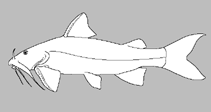
Creteuchiloglanis brachypterus is distinguished from C. gongshanensis, by having the pectoral-fin length 65.8–78.7% Pt–Pl distance (vs. 95.3–99.6%), a shorter caudal fin (11.2–12.9% SL vs. 14.7–17.8%), a shorter pectoral fin (18.5–21.8% SL vs. 25.3–28.1%), a shorter pelvic fin (14.5–18.7% SL vs. 19.2–22.2%), a larger eye (7.0–12.0% HL vs. 5.8–6.7%), and a deeper caudal peduncle (35.8–43.7% caudal-peduncle length vs. 23.5–29.7%; 6.5–8.0% SL vs. 3.8–4.6%). It is distinguished from C. kamengensis by having a shorter caudal fin (11.2–12.9% SL vs. 13.8–16.6%), a shorter pectoral fin (18.5–21.8% SL vs. 25.0–28.7%), a larger eye (7.0–12.0% HL vs. 5.1–6.4%), a shorter prepectoral length (10.0–16.1% SL vs. 16.9–17.5%), a longer post-adipose distance (9.1–11.3% SL vs. 8.2–8.8%), and by the presence (vs. absence) of pale patches on the body. Creteuchiloglanis brachypterus is distinguished from C. longipectoralis by having the pectoral-fin length 65.8–78.7% Pt–Pl distance (vs. 98.1–120.9%), i,6 dorsal-fin rays (vs. i,5), a deeper body, body depth at anus (9.6–11.8% SL vs. 7.8–8.1%), a deeper head depth (9.0–11.8% SL vs. 7.2–8.8%), a longer post-adipose distance (9.1–11.3% SL vs. 7.0–8.9%), and by the presence (vs. absence) of pale patches on the body. It is distinguished from C. macropterus by having the pectoral-fin length 65.8–78.7% Pt–Pl distance (vs. 81.4–99.8%), pelvic-fin length 46.1–59.4% Pl–A distance (vs. 60.0–66.5%), a shorter caudal fin (11.2–12.9% SL vs. 14.2–19.9%), a shorter pectoral fin (18.5–21.8% SL vs. 22.6–28.5%), and head depth 9.0–11.8% SL (vs. 13.0–14.5%) (Ref. 87311).
Body shape (shape guide): elongated.
Livscykel och parningsbeteende
Könsmognad | Reproduktion | Lek | Ägg | Fekunditet | Larver
Zhou, W., Li, X. and A.W. Thomson, 2011. A new genus of Glyptosternine catfish (Siluriformes: Sisoridae) with descriptions of two new species from Yunnan, China. Copeia 2011(2):226-241. (Ref. 87311)
Status på IUCN:s rödlista (Ref. 130435: Version 2025-2 (Global))
Hot mot människor
Harmless
Mänskliga användningsområden
Verktyg
Särskilda rapporter
Ladda ner XML
Internet-källor
Uppskattningar baserade på modeller
Index för fylogenetisk mångfald (Ref.
82804): PD
50 = 0.5039 [Uniqueness, from 0.5 = low to 2.0 = high].
Bayesian length-weight: a=0.00603 (0.00269 - 0.01352), b=3.08 (2.88 - 3.28), in cm total length, based on LWR estimates for this (Sub)family-body shape (Ref.
93245).
Trofisk nivå (Ref.
69278): 3.2 ±0.4 se; based on size and trophs of closest relatives
Resiliens (Ref.
120179): Mellan, lägsta populationsfördubblingstid 1,4-4,4 år (Preliminary K or Fecundity.).
Sårbarhet i fisket (Ref.
59153): Low vulnerability (11 of 100).
🛈