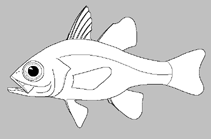
Classification / Noms
Noms communs | Synonymes | Catalog of Fishes(Genre, Espèce) | ITIS | CoL | WoRMS | Cloffa
>
Kurtiformes (Nurseryfishes, cardinalfishes.) >
Apogonidae (Cardinalfishes) > Apogoninae
Etymology: Glossamia: Greek, glossa = tongue + Greek, amia = a kind of fish (Ref. 45335); arguni: The species is named arguni with reference to the type locality, which is situated in the Arguni Bay region (Ref. 87316).
Eponymy: These are toponyms, referring to Arguni Bay, Papua Barat, Indonesia. (Ref. 128868), visit book page.
Environnement : milieu / zone climatique / profondeur / gamme de distribution
Écologie
; eau douce benthopélagique. Tropical; 3°S - 4°S, 133°E - 134°E
Asia: West Papua Province, Indonesia. Known only from freswater streams in the Arguni Bay region. This location represents the farthest west record for the genus on the island of New Guinea and is situated approximately 130 km north-west of Lake Yamur, the previous limit of distribution (Ref. 87316).
Taille / Poids / Âge
Maturité: Lm ? range ? - ? cm
Max length : 10.2 cm SL mâle / non sexé; (Ref. 87316)
Description synthétique
Clés d'identification | Morphologie | Morphométrie
Sides of the body with 5 broad bars. Scales on lateral line 43-45. Dorsal fin with 9 soft rays (Ref. 87316).
Cycle de vie et comportement reproducteur
Maturité | Reproduction | Frai | Œufs | Fécondité | Larves
Hadiaty, R.K. and G.R. Allen, 2011. Glossamia arguni, a new species of freshwater cardinalfish (Apogonidae) from West Papua Province, Indonesia. aqua, Int. J. Ichthyol. 17(3):173-180. (Ref. 87316)
Statut dans la liste rouge de l'IUCN (Ref. 130435: Version 2025-2 (Global))
Menace pour l'homme
Harmless
Utilisations par l'homme
Outils
Articles particuliers
Télécharger en XML
Sources Internet
Estimations basées sur des modèles
Indice de diversité phylogénétique (Réf.
82804): PD
50 = 0.5005 [Uniqueness, from 0.5 = low to 2.0 = high].
Bayesian length-weight: a=0.01122 (0.00521 - 0.02417), b=3.07 (2.89 - 3.25), in cm total length, based on LWR estimates for this (Sub)family-body shape (Ref.
93245).
Niveau trophique (Réf.
69278): 3.3 ±0.3 se; based on size and trophs of closest relatives
Résilience (Réf.
120179): Haut, temps minimum de doublement de population inférieur à 15 mois (Preliminary K or Fecundity.).
Vulnérabilité de la pêche (Ref.
59153): Low vulnerability (10 of 100).
🛈