Classification / Noms
Noms communs | Synonymes | Catalog of Fishes(Genre, Espèce) | ITIS | CoL | WoRMS | Cloffa
>
Cyprinodontiformes (Rivulines, killifishes and live bearers) >
Nothobranchiidae (African rivulines)
Etymology: Fenerbahce: The Turkish word 'Fenerbahçe' can have the meaning of garden lantern from 'fener' (lantern) and bahçe (garden), from which the name of a district in Istanbul, and the name of a football club might be derived (Ref. 79517); devosi: Fenerbahce devosi is named after Luc De Vos, head of the Ichthyology department of the National Museums of Kenya, who died far too young in 2003; Luc made several important fish collections in the Congo Basin, including populations of F. devosi (Ref. 87349).
Eponymy: Dr Luc De Vos (1957–2003) was a Belgian ichthyologist who was Curator of Fishes at the Nairobi Museum, Kenya. [...] (Ref. 128868), visit book page.
Environnement : milieu / zone climatique / profondeur / gamme de distribution
Écologie
; eau douce benthopélagique. Tropical
Africa: eastern part of Congo River basin near Ubundu (Ref. 87349), in Ruiki River drainage, Amabobi River and Lubilu River (Ref. 87349). Other populations from e.g. Yangambi, Yaekama, Epulu, Nikambwe and mouth of Aruwimi River, differ in certain characters and are therefore not included in this species (Ref. 87349).
Taille / Poids / Âge
Maturité: Lm ? range ? - ? cm
Max length : 2.6 cm SL mâle / non sexé; (Ref. 87349)
Description synthétique
Clés d'identification | Morphologie | Morphométrie
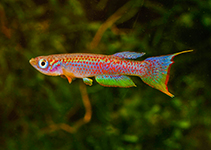
Épines dorsales (Total) : 0; Rayons mous dorsaux (Total) : 8 - 10; Épines anales: 0; Rayons mous anaux: 14 - 16; Vertèbres: 27 - 28. Diagnosis: Fenerbahce devosi shares the following combination of characters with F. formosus: small species with maximum total length below 4 cm, reflective scales dorsally on the head, complete absence of tubular structures in the pre-, post-, supraorbital, and opercular neuromast system, and small dorsal fin (Ref. 87349). All Fenerbahce specimens can be divided by the combination of several morphological characters into two clades: the western clade includes the populations from Voula to the Tshuapa River, the eastern clade the populations from the Aruwimi River to Nikambwe and Epulu; the western clade differs from the eastern clade by a more posterior insertion of the dorsal fin in relation to the anal fin, D/A=1/10–14 vs. D/A=1/7–10; a slightly lower number of vertebrae, 25–26, except in F. sp. ‘Tshuapa' 28–29, vs. 27–30; a fused hypural fan or both hypural plates only on posterior 20% not fused vs. both hypural plates not or only on anterior half fused; a mean lower number of caudal fin rays attached to hypural plates or fan, 8–9 vs. 9–10 (Ref. 87349). Fenerbahce devosi is distinguished from F. formosus by the combination of the following characters: a more robust species; observed maximum total length larger, largest observed male, kept in an aquarium, approximately 38 mm total length, not preserved, largest value given for F. formosus is 30 mm; dorsal fin inserts in a more anterior position compared to the anal fin, D/A=1/8–9, vs. a more posterior inserted dorsal fin in F. formosus, D/A=1/10–14; Fenerbahce devosi has a deeper body then F. formosus, body depth as percentage of standard length ranges from 21.7–23.2 in F. devosi and from 17.9–21.2 in F. formosus; extensions of the edges of caudal fin can be almost as long as the fin itself in adult males, in F. formosus caudal fin extensions are only half the length of the caudal fin (Ref. 87349). Body colour of males on sides yellow-green to blue-green, unpaired fins in centre blue-green to greenish vs. body pale-blue to silvery and centre of unpaired fins light blue in F. formosus (Ref. 87349). Anal fin orange to yellow-greenish, with a row of red dots at anal base and vague orange edge in F. devosi vs. pale blue with basal red stripe and discrete red edge in F. formosus; southern populations of F. formosus with red spots and/or stripes in middle section of anal fin; lower half of caudal fin orange to yellow-greenish vs. pale blue in F. formosus; dorsal fin spotted at base in F. devosi vs. a red basal stripe and complete fin spotted with inter radial red stripes in F. formosus; caudal fin spotted without inter radial red stripes in F. devosi vs. spotted with inter radial red stripes in F. formosus; pelvic fin like anal fin, yellow to blue-green with red border in F. devosi vs. pale blue with red border in F. formosus; pectoral fin in males transparent with an orange or yellow hue and small blue border vs. transparent with a light blue distal edge (Ref. 87349). Fenerbahce devosi is distinguished from F. sp. ‘Epulu’, F. sp. ‘East Congo’ and F. sp. ‘Tshuapa’ by a deeper body and a shorter head, and from F. sp. aff.devosi by some small differences in measurements and male colouration (Ref. 87349).
Body shape (shape guide): fusiform / normal.
Cycle de vie et comportement reproducteur
Maturité | Reproduction | Frai | Œufs | Fécondité | Larves
Sonnenberg, R., T. Woeltjes and J.R. van der Zee, 2011. Description of Fenerbahce devosi (Cyprinodontiformes: Nothobranchiidae), a new species of dwarf killifish from the eastern Congo Basin in the Democratic Republic of Congo. Zootaxa 2966:1-12. (Ref. 87349)
Statut dans la liste rouge de l'IUCN (Ref. 130435: Version 2025-2 (Global))
Menace pour l'homme
Harmless
Utilisations par l'homme
Outils
Articles particuliers
Télécharger en XML
Sources Internet
Estimations basées sur des modèles
Indice de diversité phylogénétique (Réf.
82804): PD
50 = 0.7500 [Uniqueness, from 0.5 = low to 2.0 = high].
Bayesian length-weight: a=0.00603 (0.00250 - 0.01453), b=3.13 (2.93 - 3.33), in cm total length, based on LWR estimates for this (Sub)family-body shape (Ref.
93245).
Niveau trophique (Réf.
69278): 3.1 ±0.4 se; based on size and trophs of closest relatives
Vulnérabilité de la pêche (Ref.
59153): Low vulnerability (10 of 100).
🛈