Elasmobranchii (haaien en roggen) (sharks and rays) >
Squaliformes (Sleeper and dogfish sharks) >
Somniosidae (Sleeper sharks)
Etymology: Centroscymnus: centr[um] (L.), prickle or sharp point, referring to spines on both dorsal fins; scymnus, an ancient name for some kind of shark, derived from a Greek word meaning young animal, cub or whelp (See ETYFish); coelolepis: coelo-, from koilos (Gr.), hollow; lepis (Gr.), scale, referring to its concave skin denticles (See ETYFish).
Milieu: milieu / Klimaatzone / Diepte / verspreidingsgebied
Ecologie
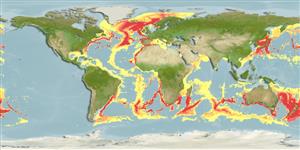
marien bathydemersaal; diepte 128 - 3700 m (Ref. 55584), usually 400 - 2000 m (Ref. 35388). Deep-water; 5°C - 13°C (Ref. 117245); 75°N - 61°S, 98°W - 147°W
Western Atlantic: Grand Banks to Delaware, USA; Cuba (Ref. 26340). Eastern Atlantic: Iceland south along Atlantic slope to the southwestern Cape coast of South Africa; also western Mediterranean. Western Pacific: off Japan, New Zealand, and Australia (Ref. 6871, 31367). Western Indian Ocean: Seychelles (Ref. 76802).
Lengte bij maturiteit / Grootte / Gewicht / Leeftijd
Maturiteit: Lm 101.8, range 95 - 110 cm
Max length : 121 cm TL mannelijk / geslacht onbekend; (Ref. 122636); common length : 92.0 cm TL mannelijk / geslacht onbekend; (Ref. 247); max. gepubliceerd gewicht: 10.1 kg (Ref. 122636)
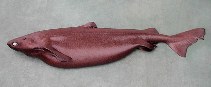
Dorsale stekels (totaal) : 2; Anale stekels: 0. Dorsal fins with very small spines, very short snout, lanceolate upper teeth and bladelike lower teeth with short, oblique cusps, stocky body that does not taper abruptly from pectoral region, very large lateral trunk denticles with smooth, circular, acuspidate crowns in adults and subadults (Ref. 247). Uniformly golden brown to dark brown in color (Ref. 6871).
Body shape (shape guide): elongated.
Found on continental slopes and abyssal plains (Ref. 6871). Feeds mainly on fish (including sharks) and cephalopods (Ref. 6871), also gastropods and cetacean meat (Ref. 5578). Ovoviviparous (Ref. 205), with 13 to 29 young per litter, born at 27-31 cm (Ref. 26346); 32-35 cm TL in North Atlantic (Ref. 98315). Utilized as fishmeal, dried and salted for human consumption, or as a source of squalene (Ref. 6871).
Ovoviviparous (Ref. 6871), with 13 to 29 young per litter (Ref. 26346). Born at 27-31 cm (Ref. 26346). Distinct pairing with embrace (Ref. 205).
Compagno, L.J.V., 1984. FAO Species Catalogue. Vol. 4. Sharks of the world. An annotated and illustrated catalogue of shark species known to date. Part 1 - Hexanchiformes to Lamniformes. FAO Fish. Synop. 125(4/1):1-249. Rome, FAO. (Ref. 247)
Status op de Rode Lijst van het IUCN (Ref. 130435: Version 2025-2 (Global))
Gevaar voor de mens
Harmless
Gebruik door de mens
Visserij: van minder commercieel belang
Tools
Speciale rapporten
Download XML
Internetbronnen
Schattingen op basis van modellen
Gewenste temperatuur (Ref.
123201): 0.8 - 10.3, mean 3.9 °C (based on 2755 cells).
Fylogenetische diversiteitsindex (Ref.
82804): PD
50 = 0.7500 [Uniqueness, from 0.5 = low to 2.0 = high].
Bayesian length-weight: a=0.00389 (0.00297 - 0.00510), b=3.12 (3.05 - 3.19), in cm total length, based on LWR estimates for this species (Ref.
93245).
Trofisch niveau (Ref.
69278): 4.5 ±0.1 se; based on diet studies.
Weerstandsvermogen (Ref.
120179): Zeer laag, minimale populatieverdubbelingstijd meer dan 14 jaar (Fec=13-29).
Prior r = 0.03, 95% CL = 0.02 - 0.05, Based on 1 full stock assessment.
Kwetsbaarheid van de visserij (Ref.
59153): High to very high vulnerability (73 of 100).
🛈
Kwetsbaarheid voor het klimaat (Ref.
125649): Moderate vulnerability (38 of 100).
🛈
Voedingsstoffen (Ref.
124155): Calcium = 4.91 [1.03, 28.49] mg/100g; Iron = 0.266 [0.063, 0.926] mg/100g; Protein = 20.1 [17.1, 22.2] %; Omega3 = 0.308 [0.110, 0.995] g/100g; Selenium = 20.9 [5.9, 65.6] μg/100g; VitaminA = 14.7 [2.8, 82.3] μg/100g; Zinc = 0.291 [0.136, 0.596] mg/100g (wet weight); based on
nutrient studies.