Klassifizierung / Names
Namen | Synonyme | Catalog of Fishes(Gattung, Arten) | ITIS | CoL | WoRMS | Cloffa
>
Gobiiformes (Gobies) >
Gobiidae (Gobies) > Gobiinae
Etymology: Eviota: No etymology given, suggested by Christopher Scharpt: from Latin 'eu' for 'true' and 'iota' for anything very small, in combination 'truly very small' referring to it as being the smallest vertebrate at the time it has benn described by Jenkins (thus, making the suggestion by Scharpt plausible; dorsopurpurea: Name from Latin 'dorsum' for back and 'purpura' for purple; referring to the purple color of the back above the lateral line.
More on authors: Greenfield & Randall.
Umwelt: Milieu / Klimazone / Tiefenbereich / Verbreitungsgebiet
Ökologie
seewasser riff-verbunden; tiefenbereich 8 - 30 m (Ref. 90102). Tropical
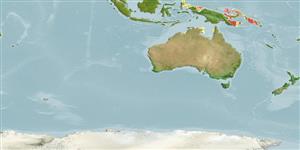
Western Pacific: Papua New Guinea.
Größe / Gewicht / Alter
Geschlechtsreife: Lm ? range ? - ? cm
Max length : 1.7 cm SL Männchen/unbestimmt; (Ref. 87726); 2.2 cm SL (female)
Kurzbeschreibung
Bestimmungsschlüssel | Morphologie | Morphometrie
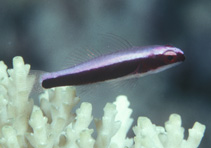
Rückenflossenstacheln (insgesamt) : 7; Rückenflossenweichstrahlen (insgesamt) : 8 - 9; Afterflossenstacheln: 1; Afterflossenweichstrahlen: 7 - 9. This species is distinguished from its congeners by the following set of characters: a dark band on lower body from snout, across the lower half of the eye back to the caudal-fin base ending in a semi-circle; larger specimens with pectoral-fin base having a reversed L-shaped row of small black dots; cephalic sensory pore system lacking the PITO and IT pores and the AITO pore enlarged; dorsal/anal fin-ray formula usually 9/9; pectoral-fin rays simple; spinous dorsal elongate or filamentous in both sexes; genital papilla nonfimbriate; in life ventral band jet black, and with purple upper half of body and top of head (Ref. 87726); characterized further by having ctenoid scales, none on head, nape and pectoral fin base; separated pelvic fins, thin membrane joins bases; depth of body 4.1-5.6 in SL (Ref. 90102).
Body shape (shape guide): elongated; Cross section: oval.
Forms groups among branches of Acopora coral, inhabits sheltered reefs in 8-30 m (Ref 90102).
Lebenszyklus und Paarungsverhalten
Geschlechtsreife | Fortpflanzung | Ablaichen | Eier | Fruchtbarkeit | Larven
Greenfield, D.W. and J.E. Randall, 2011. Two new Indo-Pacific species in the Eviota nigriventris complex (Teleostei: Gobiidae). Zootaxa 2997:54-66. (Ref. 87726)
IUCN Rote Liste Status (Ref. 130435: Version 2025-2 (Global))
Bedrohung für Menschen
Harmless
Nutzung durch Menschen
Tools
Zusatzinformationen
Download XML
Internet Quellen
Schätzungen auf der Grundlage von Modellen
Bevorzugte Temperatur (Ref.
123201): 27 - 29, mean 28 °C (based on 68 cells).
Phylogenetischer Diversitätsindex (Ref.
82804): PD
50 = 0.5000 [Uniqueness, from 0.5 = low to 2.0 = high].
Bayesian length-weight: a=0.00692 (0.00281 - 0.01706), b=3.09 (2.92 - 3.26), in cm total length, based on LWR estimates for this Genus-body shape (Ref.
93245).
Trophische Ebene (Ref.
69278): 3.1 ±0.3 se; based on size and trophs of closest relatives
Anfälligkeit der Fischerei (Ref.
59153): Low vulnerability (10 of 100).
🛈