Clasificación / Nombres
Nombres comunes | Sinónimos | Catalog of Fishes(Género, Especie) | ITIS | CoL | WoRMS | Cloffa
>
Siluriformes (Catfishes) >
Loricariidae (Armored catfishes) > Hypoptopomatinae
Etymology: Otocinclus: Greek, ous, oto = ear + Latin, cinclus = latticework; in allusion to the holes of the head in the ears (Ref. 45335).
Eponymy: Johann Paul Arnold (1869–1952) was a German aquarist in Hamburg. He sent specimens to Boulenger for study and identification. He co-wrote: The alien freshwater fish (1936). (Ref. 128868), visit book page.
More on author: Regan.
Entorno: milieu / zona climática / rango de profundidad / gama de distribución
Ecología
; agua dulce demersal. Subtropical
South America: lower río Paraná drainage, lower and middle rio Uruguai, and río de La Plata.
Tamaño / Peso / Edad
Madurez: Lm ? range ? - ? cm
Max length : 4.8 cm SL macho / no sexado; (Ref. 86395)
Descripción breve
Claves de identificación | Morfología | Morfometría
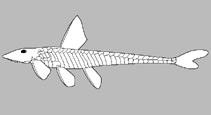
Distinguished from all congeners species except Otocinclus mimulus, by having five pectoral branched rays (vs. six pectoral branched rays), and except from Otocinclus mimulus and Otocinclus xakriaba by having the prootic involved in the contact with the hyomandibular articular condyle (vs. only compound pterotic contacting the hyomandibular articular condyle). Differs from Otocinclus mimulus by having a not elevated patch of enlarged odontodes on the postero-dorsal parietosupraoccipital tip and 15 caudal vertebrae (vs. having an elevated patch of enlarged odontodes on the parietosupraoccipital and typically having 16-17 caudal vertebrae). Can be further distinguished (except for Otocinclus affinis, Otocinclus hasemani, Otocinclus xakriaba, Otocinclus mimulus and Otocinclus flexilis) by possessing an iris operculum, and from Otocinclus affinis, Otocinclus mimulus and Otocinclus xakriaba by having a not elevated patch of enlarged odontodes on the postero-dorsal parieto-supraoccipital tip. Differs also from all remaining congeners (except for
Otocinclus xakriaba, Otocinclus flexilis, and Otocinclus mimulus) by having a lateral trunk coloration composed of either a row of 3-6 distinct dark blotches or a distinct dark stripe extending from the compound pterotic to the base of the caudal fin, or a diffuse mixture of those two color patterns (Ref. 86395).
Body shape (shape guide): elongated.
Facultative air-breathing in the genus (Ref. 126274)
Ciclo vital y comportamiento de apareamiento
Madurez | Reproducción | Puesta | Huevos | Fecundidad | Larva
Lehmann, A.P., F. Mayer and R.E. Reis, 2010. Re-validation of Otocinclus arnoldi Regan and reappraisal of Otocinclus phylogeny (Siluriformes: Loricariidae). Neotrop. Ichthyol. 8(1):57-68. (Ref. 86395)
Situación en la Lista Roja de la UICN (Ref. 130435: Version 2025-2 (Global))
Amenaza para el ser humano
Harmless
Usos humanos
Herramientas
Informes especiales
Descargar XML
Fuentes de Internet
Estimaciones basadas en modelos
Índice de diversidad filogenética (Referencia
82804): PD
50 = 0.5000 [Uniqueness, from 0.5 = low to 2.0 = high].
Bayesian length-weight: a=0.00977 (0.00434 - 0.02202), b=3.06 (2.87 - 3.25), in cm total length, based on LWR estimates for this (Sub)family-body shape (Ref.
93245).
Resiliencia (Referencia
120179): Alto, población duplicada en un tiempo mínimo inferior a 15 meses (Preliminary K or Fecundity.).
Vulnerabilidad pesquera (Ref.
59153): Low vulnerability (10 of 100).
🛈